You're tracking ecommerce customer satisfaction metrics, but you're probably tracking them wrong.
Not because you picked the wrong metric. The standard ones - CSAT, NPS, CES - are fine. The problem is that they're all survey-based, which means you're measuring satisfaction for the 5-15% of customers who bother to respond. The other 85% are a black box.
Meanwhile, you're sitting on thousands of reviews and support tickets that contain detailed satisfaction signals for nearly every customer interaction. Most ecommerce teams treat this data as customer service material, not as a measurement system. That's the gap.
This guide covers the standard ecommerce customer satisfaction metrics (with current benchmarks), then shows you how to build a more complete picture using the feedback data you already collect.
Core Customer Satisfaction KPIs and Ecommerce Benchmarks
These are the metrics every ecommerce satisfaction guide will tell you to track. They're genuinely useful - but each has a significant blind spot.
CSAT (Customer Satisfaction Score)
What it measures: How satisfied a customer was with a specific interaction or purchase, typically on a 1-5 scale.
How to calculate: (Number of satisfied responses / Total responses) x 100
Ecommerce benchmarks:
- Average: 82%
- Good: 80-85%
- Excellent: 90%+
The blind spot: CSAT captures a moment, not a trend. A customer can rate their purchase 5/5 today and quietly stop buying from you next month because a competitor launched a better product. CSAT also suffers from response bias - unhappy customers are more likely to skip the survey entirely.
NPS (Net Promoter Score)
What it measures: How likely a customer is to recommend your brand (0-10 scale). Promoters (9-10) minus Detractors (0-6) = NPS.
Ecommerce benchmarks:
- Average: +28
- Good: +40 to +55
- Excellent: +55 or above
- Leaders like Chewy and Zappos score +70 or higher
The blind spot: NPS tells you the likelihood of recommendation but not the reason behind it. A score of +30 doesn't tell you whether customers love your products but hate your shipping, or love your shipping but think your prices are too high. You get a number without a diagnosis.
CES (Customer Effort Score)
What it measures: How easy it was for a customer to accomplish a task (buy a product, get a support issue resolved, complete a return).
Ecommerce benchmarks: Less standardized than CSAT or NPS, but generally measured on a 1-7 scale where lower is better. Scores below 3 indicate a smooth experience.
The blind spot: CES works best for transactional moments (checkout, returns, support). It doesn't capture product satisfaction at all. A customer can have a frictionless checkout experience and still be disappointed when the product arrives.
The Shared Problem
All three metrics share the same fundamental limitation: they require customers to fill out a survey. Survey response rates for ecommerce brands typically range from 5-15%, which means you're making decisions based on a small, self-selecting sample.
Reviews and support tickets don't have this problem. They're generated organically, at much higher volumes, and they contain far more detail than any survey response.
Satisfaction Signals You Already Collect
You don't need to send another survey to measure customer satisfaction. You already have the data - it's just sitting in systems you might not think of as measurement tools.
Star ratings (the obvious one)
Average star rating is the most visible satisfaction metric in ecommerce, and it's useful as a top-level indicator. But as a diagnostic tool, it's weak. A product with a 3.8-star average could have that score because most people gave it 4 stars, or because it has a polarized mix of 5-star and 1-star reviews. The distribution matters more than the average.
What star ratings miss is the why. Two products can both have 4.0-star averages, but one is loved for its design and criticized for durability, while the other is praised for value but knocked for poor packaging. Knowing the themes behind the ratings is what turns a number into a fix.
Review sentiment by theme
This is the metric most ecommerce teams aren't tracking, and it's the most useful one. Instead of asking "what's our average star rating?", ask "what's the sentiment for sizing accuracy across our top 20 products?"
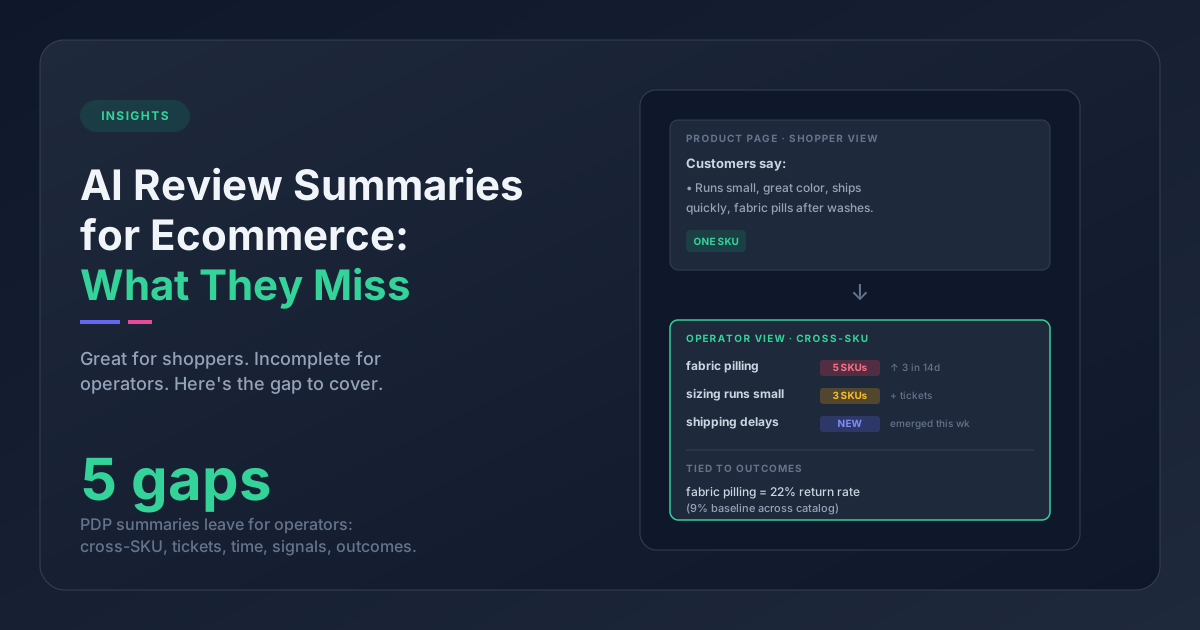
Theme-level sentiment tracking turns reviews from a vanity metric into a diagnostic tool. When you categorize customer feedback into themes like quality, sizing, shipping, packaging, and value, you can:
- Compare sentiment across products for the same theme
- Track whether specific themes are improving or declining over time
- Identify which themes have the biggest impact on overall satisfaction
- Spot emerging problems before they become widespread
Support ticket volume and themes
Support tickets are a direct measure of friction. Every ticket represents a customer who had a problem significant enough to contact you about it. Track:
- Tickets per 100 orders by product - High ratios signal products that create confusion or disappointment
- Top ticket themes by product - Are customers asking about sizing? Compatibility? Assembly instructions? Each theme points to a specific fix.
- Resolution time and satisfaction - Customers whose issues are resolved quickly are significantly more likely to purchase again
When you analyze reviews and support tickets together, the combined picture is more accurate than either source alone.
CSAT from helpdesk platforms
If you use a helpdesk tool like Gorgias, Zendesk, or eDesk, you're probably already collecting CSAT on support interactions. This data is valuable but often siloed in the helpdesk and never connected to product-level analysis.
A product that consistently generates low-CSAT support interactions is telling you something about the product, not just about the support experience.
Warning Signs vs. Confirmation Metrics
This distinction matters more than most merchants realize.
Confirmation metrics tell you what already happened:
- Overall CSAT score
- NPS score
- Average star rating
- Return rate
- Repeat purchase rate
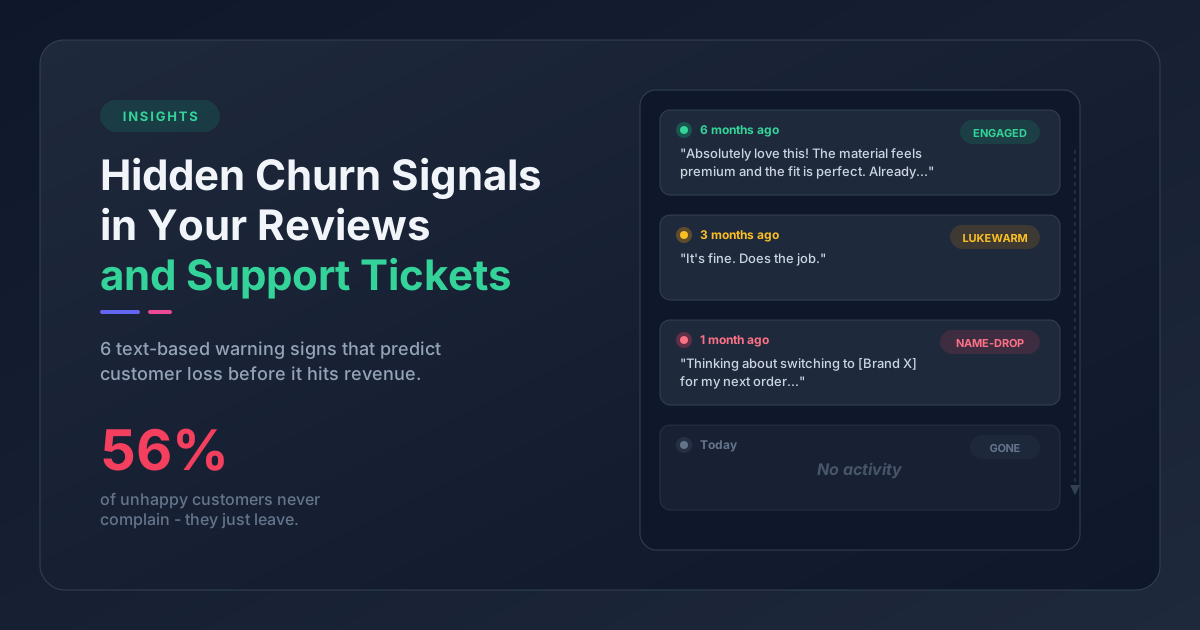
Warning signs tell you what's about to happen:
- Emerging negative themes in reviews (a new complaint pattern appearing)
- Rising support ticket volume on a specific product
- Sentiment shift on a theme that was previously positive
- Increasing mentions of competitor names in reviews
Warning signs give you weeks or months of advance notice. When more customers start complaining about material quality across your catalog, your CSAT score won't reflect it for another quarter. But the individual reviews are already telling you.
The most effective satisfaction measurement combines both: confirmation metrics to validate trends, warning signs to catch problems early.
Product-Level Satisfaction: The Missing Dimension
Almost every satisfaction framework measures at the store level. "Our CSAT is 82%." "Our NPS is +35." These numbers are useful for board decks but nearly useless for operational decisions.
The reality is that satisfaction varies enormously by product. You might have a store-level CSAT of 85%, but that average masks:
- A bestseller with 95% satisfaction that pulls the average up
- A new product line with 65% satisfaction that's quietly damaging your brand
- A seasonal product with declining satisfaction that nobody noticed because it's a small percentage of total volume
Product-level satisfaction measurement means tracking:
- Average rating per product (baseline)
- Theme sentiment per product (diagnostic)
- Support ticket rate per product (friction indicator)
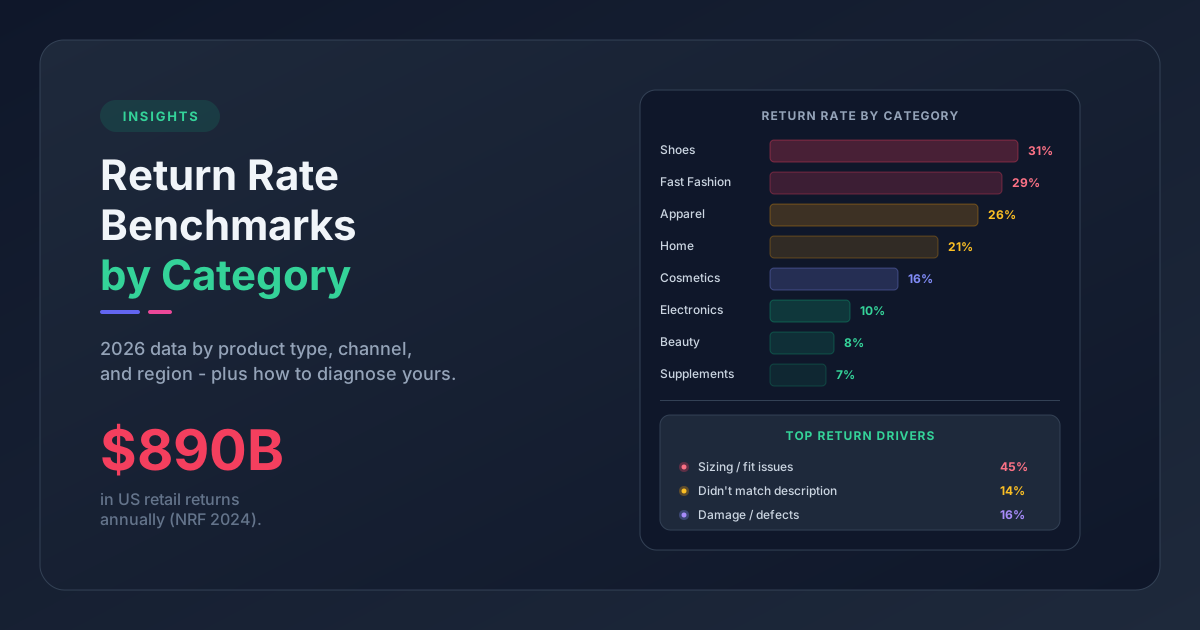
- Return rate per product (outcome measure)
When you stack these metrics for a single product, the story becomes clear. A product with a 4.2-star average, negative sizing sentiment, high ticket rate, and above-average returns has a sizing problem. The star rating alone wouldn't tell you that.
How to Measure Customer Satisfaction in Ecommerce Without Surveys
Here's a practical framework for measuring customer satisfaction using data you already have, no new surveys required.
Tier 1: Top-line health (check weekly)
| Metric | Source | What it tells you |
|---|---|---|
| Average star rating | Reviews | Overall satisfaction direction |
| Review volume trend | Reviews | Customer engagement level |
| Support ticket rate | Helpdesk | Overall friction level |
Tier 2: Theme-level diagnostics (check monthly)
| Metric | Source | What it tells you |
|---|---|---|
| Sentiment by top 5 themes | Reviews | Which experience areas are improving or declining |
| New emerging themes | Reviews | Potential new problems surfacing |
| Top ticket themes | Helpdesk | What's generating the most friction |
Tier 3: Product-level deep dives (check per product, trigger-based)
| Metric | Source | What it tells you |
|---|---|---|
| Theme sentiment per product | Reviews | Why this specific product's satisfaction differs |
| Ticket rate per product | Helpdesk | Whether friction is product-specific or systemic |
| Return rate per product | Returns data | Final outcome validation |
Pattern Owl handles Tier 2 and Tier 3 automatically - connect your reviews and helpdesk, and it groups complaints by product and theme so you can see "sizing accuracy dropped 15% on Product X" without reading hundreds of reviews.
When You Still Need Surveys
Feedback-derived metrics cover a lot of ground, but surveys still have a place:
Post-purchase surveys capture the "silent majority" - customers who neither review nor contact support. A short 2-3 question survey sent 7-14 days after delivery fills the gap. Focus on questions that uncover specific themes, not just numeric ratings.
NPS surveys are useful for benchmarking against industry peers, since NPS is the most standardized metric across ecommerce. Run them quarterly, not continuously.
CES surveys make sense at high-friction touchpoints: after a return, after a support interaction, after checkout for first-time buyers. Keep them short - one question, triggered by a specific event.
The key is to use surveys to validate and supplement what your review and ticket data already shows - not as your primary measurement system.
Metrics That Actually Drive Action
After tracking customer satisfaction across dozens of ecommerce brands, here's what we've found separates useful measurement from vanity measurement:
Track at the theme level, not just overall. "Our CSAT is 82%" doesn't tell anyone what to do. "Sizing sentiment dropped 15% on our denim line in the last 60 days" tells the product team exactly where to focus.
Compare products against each other, not just against benchmarks. If Product A has 90% positive sizing sentiment and Product B has 60%, the fix isn't a new size chart for every product - it's a deep dive into Product B's specific sizing issues.
Pair warning signs with confirmation metrics. When theme sentiment improves, check whether return rates and repeat purchase rates follow 4-8 weeks later. If they do, your feedback analysis is working. If they don't, the issues might be in areas your themes aren't capturing.
Set targets on things you can control. You can't directly control your NPS score. You can control whether you fix the top three complaint themes for your highest-volume products. Tie your satisfaction targets to specific theme improvements, and the score-level metrics will follow.
Frequently Asked Questions
What are the most important customer satisfaction KPIs for ecommerce?
The core KPIs are CSAT (Customer Satisfaction Score), NPS (Net Promoter Score), and CES (Customer Effort Score). However, feedback-derived metrics like theme-level sentiment from reviews and support ticket rates per product often provide more useful insights because they don't depend on survey response rates and they tell you why satisfaction is high or low, not just the score.
How do you measure customer satisfaction in ecommerce without surveys?
Track star rating distributions, review sentiment by theme (sizing, quality, shipping), support ticket volume per product, and CSAT scores from helpdesk platforms. These signals cover a much larger portion of your customer base than surveys, which typically get 5-15% response rates.
What is a good CSAT benchmark for ecommerce?
The average ecommerce CSAT score is 82%. Scores between 80-85% are considered good, and 90% or above is excellent. However, store-level CSAT can mask significant product-level variation, so tracking satisfaction per product is more useful than a single aggregate number.
Measuring Ecommerce Customer Satisfaction: What Actually Matters
The ecommerce customer satisfaction metrics that matter most aren't the ones that look good on a dashboard. They're the ones that tell you specifically what's wrong and where to fix it.
Standard metrics like CSAT, NPS, and CES give you the score. Review and ticket analysis gives you the story. The stores that improve fastest are the ones that stop asking "what's our satisfaction score?" and start asking "what are customers actually saying about sizing, quality, and packaging for each of our products?"
Pick your three highest-volume products. Check the review themes. Check the support tickets. That's your starting point for a satisfaction measurement system that actually drives improvement.
See what your customers are really saying - Pattern Owl groups review and ticket feedback by product and theme, so you get satisfaction metrics you can act on without reading every review.