You check your average rating every morning. It's 4.3 stars. That feels fine - solid, even. But your return rate crept up 8% last quarter, a new product isn't getting reorders, and your support team keeps fielding the same complaint about a product that supposedly has great reviews.
The problem isn't your star rating. The problem is what star ratings miss about your customer feedback: they compress everything your customers are trying to tell you into a single number. And that number hides more than it reveals.
Research from Northwestern's Spiegel Research Center found that the written content of reviews influences purchase decisions more than star ratings alone. Your customers already know that. The question is whether your team does too.
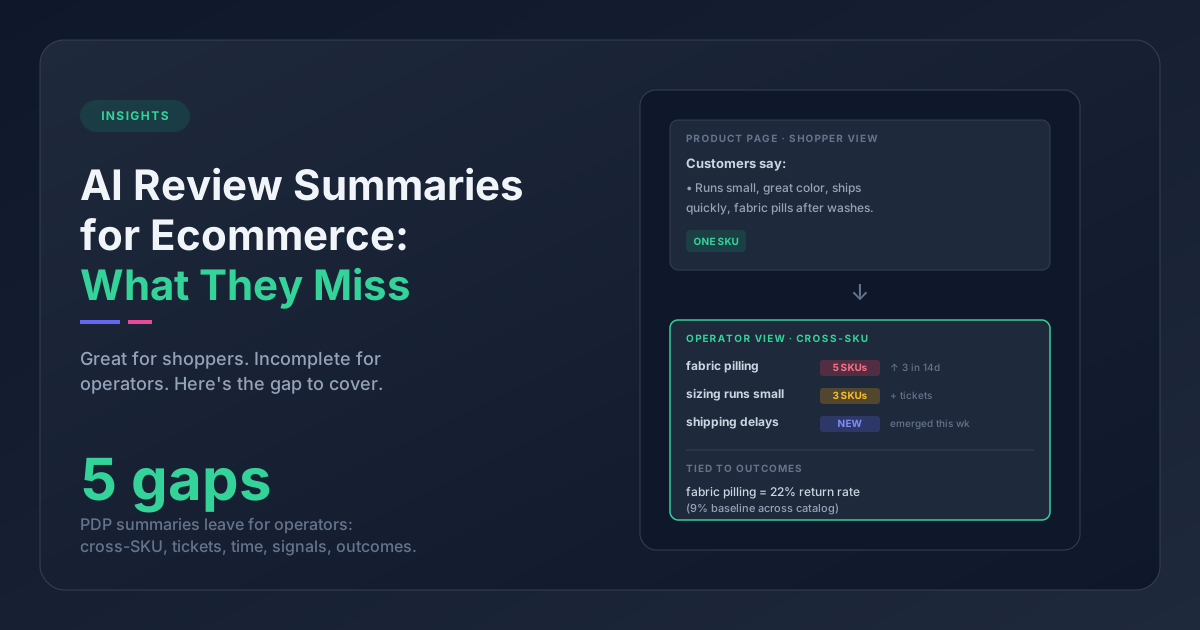
Here are five patterns that only surface when you look past the stars - the kind of signals a feedback intelligence platform pulls out automatically, including sentiment shifts buried inside otherwise strong ratings.
1. The Return Drivers Hiding in 4-Star Reviews
Four-star reviews are the "yes, but" of customer feedback. The customer liked your product enough to leave a positive rating - but something wasn't quite right. And that something is usually specific enough to act on.
"Love the jacket but it runs a full size large."
"Great quality, just wish the color was closer to the photo."
"Exactly what I wanted - had to exchange for a smaller size though."
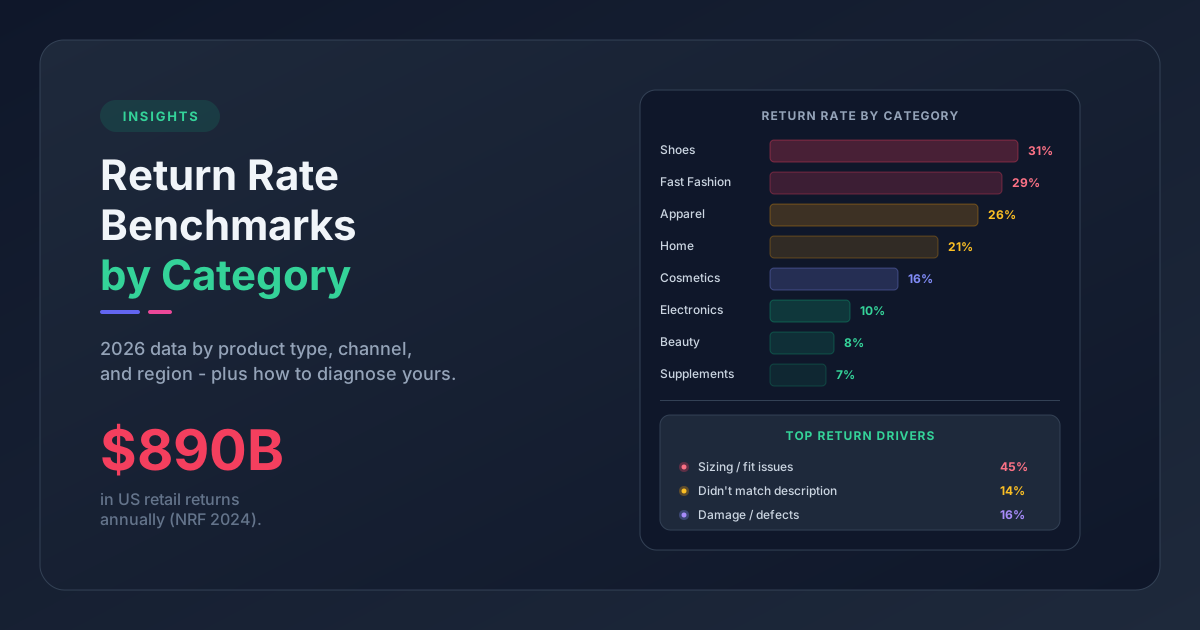
These reviews won't tank your average. A string of 4-star ratings barely moves the needle on a product sitting at 4.2. But if thirty customers are saying the same thing in the review text - that your sizing runs large, that the color doesn't match the listing - you have a return driver that your star rating will never flag.
Here's what makes this dangerous: the customers who don't leave reviews just return the product silently. For every reviewer who writes "runs large," several more hit the return button without telling you why. The 4-star reviews are your early warning system, but only if you read the text.
What to look for: Filter your reviews by 3-4 stars and scan for recurring phrases about fit, color, material feel, or "not what I expected." Those phrases point directly at listing accuracy and product spec issues - both of which are fixable.
2. Feature Requests Your Customers Are Already Making
Five-star reviews seem like pure good news. But buried in the praise, customers are telling you exactly what to build next.
"Absolutely love this protein powder - wish it came in a single-serve packet for travel."
"Perfect daily moisturizer. Would buy the SPF version in a heartbeat."
"My dog goes crazy for these treats. Any chance you'll make a larger bag?"
These aren't complaints. They're product development signals delivered for free, by people who already love what you sell. Most brands never see them because they categorize 5-star reviews as "positive" and move on.
A supplement brand analyzing review text might discover that 12% of their 5-star reviews mention wanting a capsule form of their powder product. That's not an insight you'll find in a 4.7-star average. It's a product line extension handed to you by the people most likely to buy it.
What to look for: Search your positive reviews for phrases like "wish it," "would love if," "only thing missing," or "hope you'll." These fragments consistently contain embedded feature requests and variant ideas.
3. Quality Shifts That Precede Rating Drops
By the time your star rating drops noticeably, the underlying problem has been compounding for weeks.
Star averages are lagging indicators. They're smoothed across hundreds or thousands of reviews, so a single bad batch or supplier change takes a long time to show up in the number. But the review text shifts immediately.
Picture this: a pet food brand has steady 4.4-star reviews for months. Then a supplier changes the protein source slightly. The star average barely moves - maybe dips to 4.3. But in the review text, mentions of "my dog won't eat it" or "different smell than before" spike from 2% of reviews to 14% over three weeks.
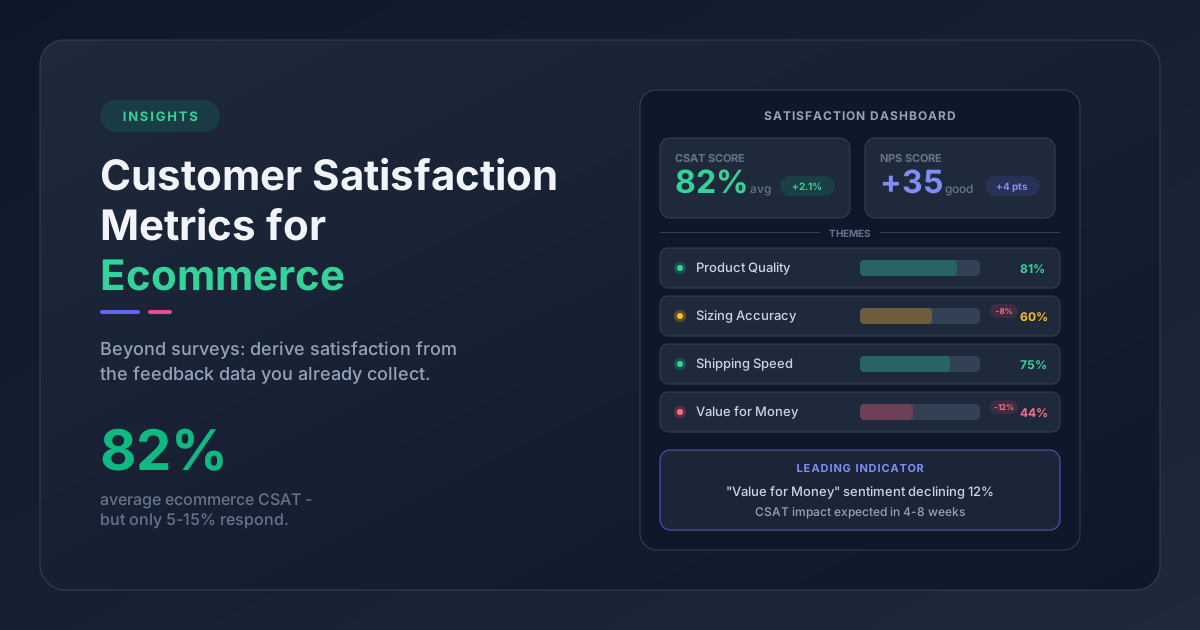
If you're watching the star rating, everything looks fine. If you're tracking theme frequency in the text, you caught the problem before it snowballed into a rating collapse and a wave of returns. Tools that find patterns in customer reviews can surface these theme frequency shifts automatically.
This is especially critical for brands sourcing products internationally or working with contract manufacturers, where formulation and material changes can happen without your direct visibility. The review text is often the first place those changes surface.
What to look for: Track how often specific negative themes appear as a percentage of total reviews over time. A spike in a single theme - even while the overall rating holds steady - is an early warning worth investigating immediately.
4. The Gap Between What Reviews Say and What Support Tickets Say
Reviews are public. Support tickets are private. And customers behave very differently in each channel.
In a review, a customer might write: "Beautiful skincare set, really nice packaging." In a support ticket the same week, a different customer writes: "The pump on my moisturizer broke after three uses and product leaked everywhere."
Both are describing the same product. But the review paints a picture of a beloved item, while the support ticket reveals a mechanical failure that's generating replacements and refunds you're eating the cost on.
This gap is more common than most brands realize. Customers often reserve their harshest feedback for private support channels, while their public reviews focus on the product experience itself. A brand looking only at reviews sees a 4.5-star product. A brand looking only at support tickets sees a product with a packaging defect. Neither view is complete.
When ecommerce teams analyze reviews and support tickets together, they catch problems that neither channel reveals on its own. A theme appearing in both - "pump broke" in support tickets and "packaging could be sturdier" in reviews - confirms the issue is real and widespread, not a one-off.
What to look for: Compare your top five support ticket themes against your top review themes for the same product. Where they overlap, you have a confirmed problem. Where support tickets show issues that reviews don't mention, you have a hidden cost center. For a deeper look at mining private channels, our guide on using support tickets for product improvements covers the complete workflow.
5. Sentiment Trends That Ratings Flatten
A 1-to-5 star scale has five values. Actual customer sentiment is far more granular than that.
Two products can both sit at 4.2 stars and have completely different feedback profiles. Product A's reviews are consistently warm - "solid product, does what it says, would buy again." Product B's reviews are polarized - a mix of enthusiastic 5-star reviews and frustrated 2-star reviews that average out to the same number.
The star rating treats these products identically. But Product B has a problem that Product A doesn't, and the only way to see it is in the text.
Here's a counterintuitive finding that illustrates why ratings alone mislead: research has shown that purchase likelihood actually peaks around 4.0-4.7 stars and decreases for products rated above 4.7. Shoppers distrust perfection. They're reading the review text to calibrate how much to trust the number - and if the text doesn't match the rating, they bounce.
Review text analysis captures this nuance in ways star ratings alone cannot. It can tell you that a product's positive reviews are becoming less enthusiastic over time (shorter, less detailed, fewer superlatives) even while the star average holds steady. That's a leading indicator of a product entering its decline phase - something a rating alone would take months to surface.
What to look for: Don't just track average star ratings over time. Track the distribution of ratings (are you becoming more polarized?) and the qualitative tone of positive reviews (are fans getting less enthusiastic?). Both of these trends are invisible in the average.
What to Do With These Patterns
The five patterns above share a common thread: they live in the text of your customer feedback, not in the numbers. Catching them requires reading your reviews differently - not one by one, but as a dataset where recurring themes and shifts matter more than individual data points.
Three practical approaches, depending on your scale:
Under 200 reviews: Export to a spreadsheet and manually tag themes. Focus on 3-4 star reviews first - they contain the most actionable detail. Track which themes appear most often and which ones correlate with returns or support tickets. Our guide to categorizing customer feedback walks through a practical tagging system.
200-1,000 reviews: Keyword frequency analysis gets you directional insights without reading every review. Search for specific phrases ("runs large," "broke after," "wish it") and tally results by product. It's not perfect - synonyms and context will slip through - but it catches the biggest patterns. For a structured approach, see how to automate review analysis at this scale.
1,000+ reviews: At this volume, manual approaches stop scaling. AI-powered theme extraction tools can process thousands of reviews and support tickets in minutes, grouping them by semantic meaning rather than exact keywords. Pattern Owl does this specifically for ecommerce brands, connecting to platforms like Judge.me, Yotpo, and RaveCapture and surfacing patterns across your entire catalog automatically.
Whatever method you use, the shift is the same: move beyond star ratings as a summary of customer sentiment. They're a headline. The story is in the text.
Frequently Asked Questions
Why are star ratings not enough for ecommerce brands?
Star ratings compress all customer sentiment into a single number between 1 and 5. They cannot capture recurring themes like sizing issues, feature requests, or quality shifts that appear in the text of reviews. Brands that rely only on star averages miss the specific, actionable patterns that drive returns, product decisions, and customer retention.
How do you analyze review text beyond star ratings?
At small scale (under 200 reviews), export reviews to a spreadsheet and tag recurring themes manually. At larger scale, AI-powered tools use theme extraction to group thousands of reviews and support tickets by meaning, surfacing patterns that keyword searches and star averages cannot detect. Our guide to finding patterns in customer reviews covers three methods in detail.
What is review text analysis in ecommerce?
Review text analysis is the practice of examining the written content of customer reviews - not just the star rating - to identify recurring themes, sentiment trends, feature requests, and quality issues. It treats reviews as qualitative data rather than a single satisfaction score, helping ecommerce teams make specific product and operational decisions based on what customers actually write.
The Brands That Win Read Between the Stars
The ecommerce brands that consistently outperform on retention and repeat purchase rates aren't the ones with the highest star ratings. They're the ones that treat customer feedback - reviews, tickets, all of it - as a continuous data stream about what's working, what's breaking, and what to build next.
Your star average will tell you that things are "fine." Your review text will tell you what "fine" is actually hiding. The gap between those two is where your best product decisions live.