Ecommerce sentiment analysis scores your review text as positive, negative, or neutral at scale, revealing what star ratings miss: customers praising or complaining about specific aspects (shipping, fit, durability) inside otherwise unambiguous ratings.
Ecommerce sentiment analysis for reviews usually gets explained two ways. Either it's an academic NLP paper that's useless for anyone trying to run a store, or it's a vendor pitch that glosses over how any of it actually works. Neither helps you decide whether to use it, how to use it, or what it'll change about your business.
This guide covers the practical version: what sentiment analysis can tell you about your reviews, where it falls short, and how to use it to make actual product and CX decisions. No jargon, no hype, no "leverage AI to unlock insights" sentences.
What Ecommerce Sentiment Analysis Actually Measures on Reviews
Sentiment analysis is the process of scoring text as positive, negative, or neutral. Applied to ecommerce reviews, it's a way to quantify emotional tone at scale without reading every review yourself.
At its simplest, a sentiment score is a label: positive, negative, neutral. More sophisticated systems return a continuous score from -1 to +1, or break sentiment into finer categories like strongly positive, mildly positive, mixed, mildly negative, and so on.
The useful thing sentiment analysis does in ecommerce isn't classifying individual reviews - your star ratings already do that. The useful thing is revealing gaps between what a customer said and what they rated. A five-star review with a sentence like "worked fine, but the box arrived beaten up" contains negative sentiment about packaging that the star rating hides completely. Sentiment analysis on review text catches that. Star ratings don't.
Why Star Ratings Aren't Enough
If star ratings captured everything, you wouldn't need sentiment analysis. But they don't.
Star ratings compress multi-dimensional feedback into one number. A review that praises the product and complains about shipping gets a single rating that averages both. Sentiment analysis can separate the two.
Star ratings are culturally and platform-specific. What's a four-star experience to one customer is a three-star experience to another. Text is harder to game and more descriptive of what actually happened.
Star ratings miss the reviews that don't have them. Support tickets, post-purchase survey responses, and social comments don't come with a star rating. Sentiment analysis is the only practical way to score them.
Star ratings don't show direction. A five-star review from a delighted customer and a five-star review from a repeat customer who's slightly disappointed both show up as "5." Sentiment analysis on the text distinguishes them.
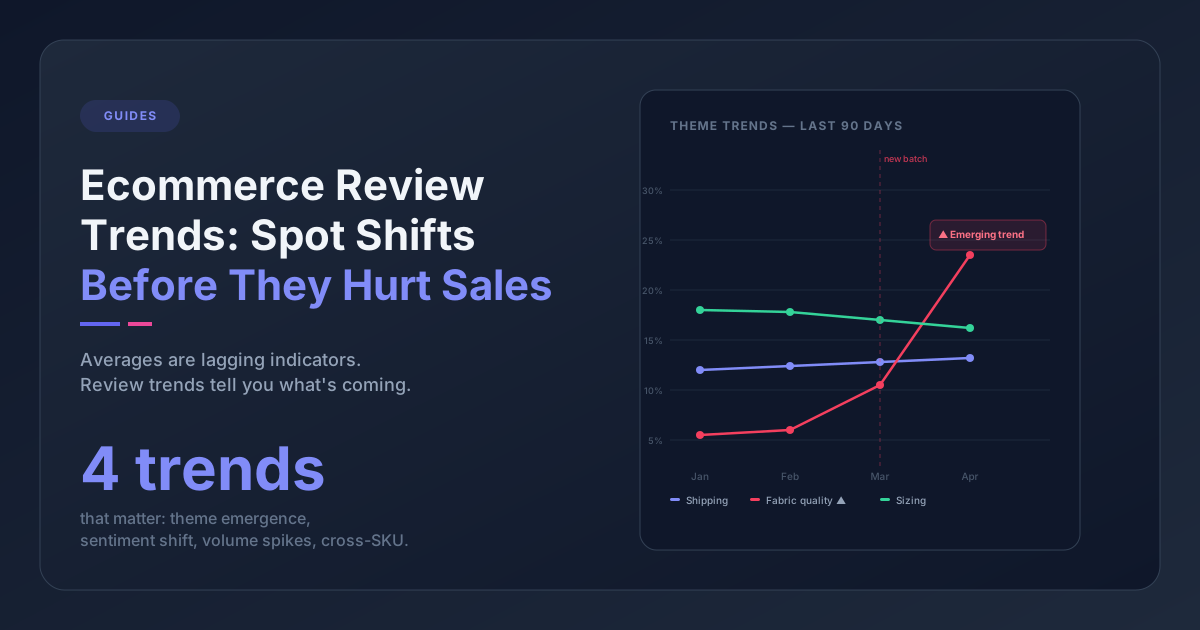
For ecommerce brands, this last one matters more than it sounds. Sentiment in your 5-star reviews usually slips two to four weeks before your star average does. If you're only watching stars, you'll see the problem after it's already cost you revenue.
How Review Sentiment Analysis Actually Works
You don't need to understand the math to use sentiment analysis, but you should understand what's under the hood so you know where it breaks.
Three broad approaches exist:
Dictionary-Based
The oldest approach. You have a list of positive words (great, love, perfect) and negative words (broken, terrible, disappointed), and you count them up. Easy to build, cheap to run, and bad at almost everything else. Dictionary-based sentiment analysis misses sarcasm, negation ("not great"), and context entirely.
Traditional Machine Learning
Models trained on labeled data - usually reviews tagged with sentiment - learn to classify new text. Better at context than dictionary methods but still struggles with domain-specific language. A model trained on movie reviews will guess wrong on ecommerce reviews because the vocabulary and structures are different.
Modern Transformer-Based Models
LLMs and models like BERT, RoBERTa, and GPT variants are what most modern tools use under the hood. They understand context, negation, sarcasm, and mixed sentiment much better than older approaches.
In practice, for ecommerce use cases, the accuracy difference between a mid-quality transformer model and a top-tier one is usually overshadowed by other factors: whether it can handle multiple languages, whether it tells you what the sentiment is about rather than just an overall positive/negative score, and whether it integrates with the data sources you actually use.
Sentence-Level vs. Aspect-Based Sentiment
Here's where most generic tools fall short. Classifying a whole review as "positive" or "negative" isn't very useful when the review says both good and bad things.
Aspect-based sentiment analysis (ABSA) is the version that matters for ecommerce. It identifies what the review is about and the sentiment for each aspect separately. A review like:
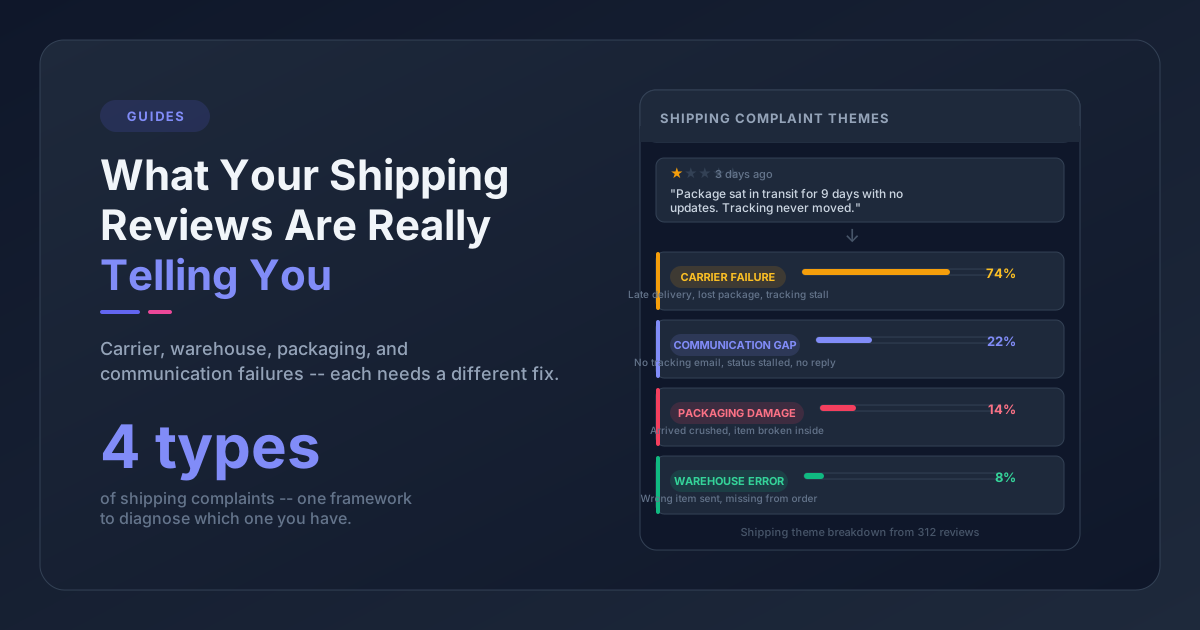
"Love the fit, exactly what I was hoping for. Shipping took forever and the packaging was crushed by the time it arrived."
has three aspects:
- Fit: positive
- Shipping speed: negative
- Packaging: negative
Scoring the whole review as "mixed" or even "positive" based on the dominant tone loses most of the signal. Scoring each aspect separately tells you specifically what's working and what's not.
For ecommerce brands, aspect-based sentiment is the version that drives decisions. It's also the version that benefits most from combining with theme extraction - because the themes define the aspects you want sentiment for.
Practical Uses of Review Sentiment Analysis for Ecommerce
Here's what ecommerce teams actually use review sentiment analysis for, ranked by payoff.
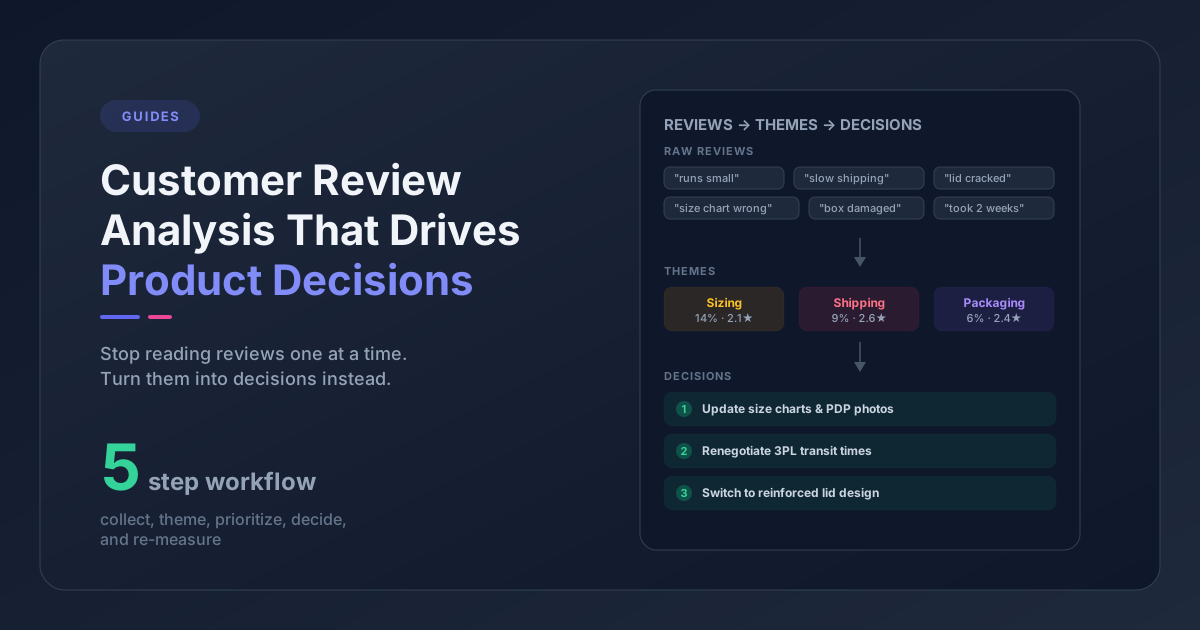
1. Catching Quality Drifts Before Star Ratings Move
This is the highest-value application. Sentiment in review text moves before star averages do. When customers start describing the same product in slightly more negative terms - "okay quality" replacing "great quality" - that's an early warning. If you're only watching star ratings, you'll notice the drift weeks later.
A weekly sentiment report on your top 10 SKUs, segmented by theme, will flag this pattern before it becomes a revenue problem.
2. Comparing Products by What Customers Complain About
Two products might have the same 4.5-star average, but the complaints underneath look completely different. One has sizing issues, the other has packaging damage. Aspect-based sentiment tells you where to focus your product team's attention SKU by SKU.
3. Measuring the Impact of a Fix
You change your size chart for a product with fit complaints. Did it work? Sentiment on the "sizing" aspect for that product, before vs. after, gives you a concrete answer. Tracking overall star ratings is too noisy - the sentiment on the specific aspect is cleaner.
4. Cross-Channel Sentiment Comparison
The way customers describe your product in Judge.me reviews might be systematically different from how they describe it in Trustpilot or Amazon reviews, and different again from how they describe it in your helpdesk tickets. Sentiment analysis across channels shows you which channel is telling the truth. If Amazon reviews are harsher than Judge.me reviews for the same product, that gap is usually a real product problem your owned channel isn't catching. For Shopify stores running Judge.me or Yotpo reviews, sentiment analysis on the text is often the fastest way to spot product issues the on-site reviews alone won't show.
5. Informing Marketing Copy
If sentiment consistently spikes on a particular aspect of a product - "the fabric" or "how easy it is to assemble" or "the packaging" - that's the hook for your next ad. The words your happiest customers use are better than anything a copywriter can invent.
Where Sentiment Analysis Breaks
Being realistic: sentiment analysis isn't magic, and anyone who pitches it as a fix-everything tool is overselling. Here are the places it genuinely struggles.
Sarcasm. "Great, another broken product" reads as positive to most models. Humans catch this instantly. Sarcasm rates in reviews are usually low enough that it doesn't distort aggregate metrics much, but it matters when you're reading individual examples.
Mixed reviews with subtle trade-offs. "I was disappointed at first but it grew on me" contains a temporal shift that's hard to classify. Aggregated, these tend to wash out. Individually, they're messy.
Domain-specific language. If your brand sells technical products - supplements, skincare, electronics - a generic model won't understand that "breakout" is negative for skincare but positive for a new product launch. Domain fine-tuning helps.
Short reviews. "Great" and "bad" are easy. "Ok I guess" is harder. Reviews under ten words give sentiment analysis the least to work with, and aggregate quality depends on how many of your reviews fall below that threshold.
Non-English reviews. Accuracy varies dramatically by language. If a material share of your reviews are in languages other than English, check what your tool supports before committing.
How to Choose a Sentiment Analysis Approach for Your Store
For most ecommerce brands, the question isn't "should we do sentiment analysis?" - it's "what's the simplest version that gives us useful signal?"
DIY with Off-the-Shelf Models
If you have a technical team, you can run pre-trained models from Hugging Face or call an API directly. Cheap to run but requires engineering to tie the output into dashboards, handle updates, and deal with errors. Usually worth it only if you have very specific needs that off-the-shelf tools don't address.
General NLP / Analytics Platforms
Platforms like MonkeyLearn, AWS Comprehend, and Google Natural Language offer sentiment analysis as a generic service. They work but aren't ecommerce-specific. You'll still need to glue them into your review platforms, ticket system, and business metrics.
Ecommerce-Specific Feedback Analytics Tools
The lowest-setup option if you're not a technical team. Tools purpose-built for ecommerce feedback already know what aspects to look for (sizing, shipping, quality, etc.), connect to your review and helpdesk platforms, and segment sentiment by product and time automatically. Pattern Owl is one example. It pulls reviews from Judge.me, Yotpo, and RaveCapture alongside tickets from Gorgias, Zendesk, and eDesk. Then it groups what customers are actually talking about - sizing, packaging, shipping - and tracks sentiment on each one week over week.
The right choice depends on volume and technical resources. If you have under 500 reviews a month, manual review of a sample paired with a light sentiment tool is usually enough. Above that volume, or if you're running across multiple products and channels, a purpose-built tool will save significant time.
Frequently Asked Questions
Is sentiment analysis accurate enough to make decisions from?
For aggregate patterns, yes. Modern sentiment analysis tools are accurate enough that directional trends (product X is getting more negative mentions on packaging this month) are reliable. For individual reviews, accuracy is still below human, so spot-check before acting on a single example.
Do I need sentiment analysis if I already have star ratings?
Star ratings tell you the score. Sentiment analysis tells you why, and catches issues that don't move the star rating. If you only have a handful of reviews per product, star ratings are enough. Once you have real volume, sentiment analysis on the text surfaces things star ratings can't.
How often should I look at sentiment data?
Weekly for top SKUs, monthly for your full catalog. Sentiment shifts tend to show up over periods of weeks, not days - checking daily is usually noise.
Can sentiment analysis work on non-English reviews?
Modern transformer models handle many languages reasonably well, but accuracy varies. If your store sells internationally, check the languages your tool supports and spot-check the output on a sample in each language you care about.
What's the difference between sentiment analysis and theme extraction?
Sentiment analysis measures tone (positive, negative, neutral). Theme extraction identifies topics (sizing, shipping, quality). Used together, they score how customers feel about each topic separately - which is more useful for product decisions than either one alone.
The Practical Takeaway
Sentiment analysis isn't valuable because it's fancy. It's valuable because it turns thousands of free-text reviews and tickets into something you can actually look at in under five minutes. The ecommerce brands that get the most out of it treat it like a weather gauge - glance at it often, notice when something shifts, and investigate the cause.
Start with aspect-based sentiment on your top five products, track it weekly, and watch for drifts. Nine times out of ten, the first thing that surprises you will be a gap between what star ratings say and what the text actually says. That gap is where the useful product and CX decisions live.