To find patterns in customer reviews, pick one of three methods by volume: manual spreadsheet tagging (under 200 reviews), semi-automated keyword clustering (a few thousand), or AI theme extraction (the only approach that scales past that). Start with the smallest method that fits your review volume.
Learning how to find patterns in customer reviews is one of the highest-leverage things an ecommerce CX team can do. This guide covers three methods - from manual spreadsheet tagging to AI-powered theme extraction - so you can spot the trends that drive returns, churn, and loyalty without reading every review yourself.
The Problem With Reading Reviews One by One
Your brand probably has hundreds - maybe thousands - of customer reviews sitting across platforms right now. And if you're like most ecommerce teams, you skim them when you have time, flag the angry ones, and move on.
That's a problem. Not because individual reviews don't matter, but because the real value lives in aggregate patterns that no single review can show you.
Consider this: 99% of consumers read reviews before purchasing, and 93% say reviews directly influence their buying decisions. Your customers are reading your reviews more carefully than you are. They're forming opinions based on patterns they spot across five or ten reviews - recurring mentions of slow shipping, sizing complaints, or packaging issues.
Meanwhile, your team is reacting to reviews one at a time instead of asking the question that actually drives product and CX decisions: what are our reviews telling us at scale?
The good news is that finding patterns in review data isn't complicated. It just requires a different approach than reading reviews individually, plus a way to track how sentiment shifts for specific products over time.
What Review Patterns Actually Look Like in Ecommerce Data
Before jumping into methods, it helps to understand what you're looking for. Review patterns fall into three categories.
Theme Clusters
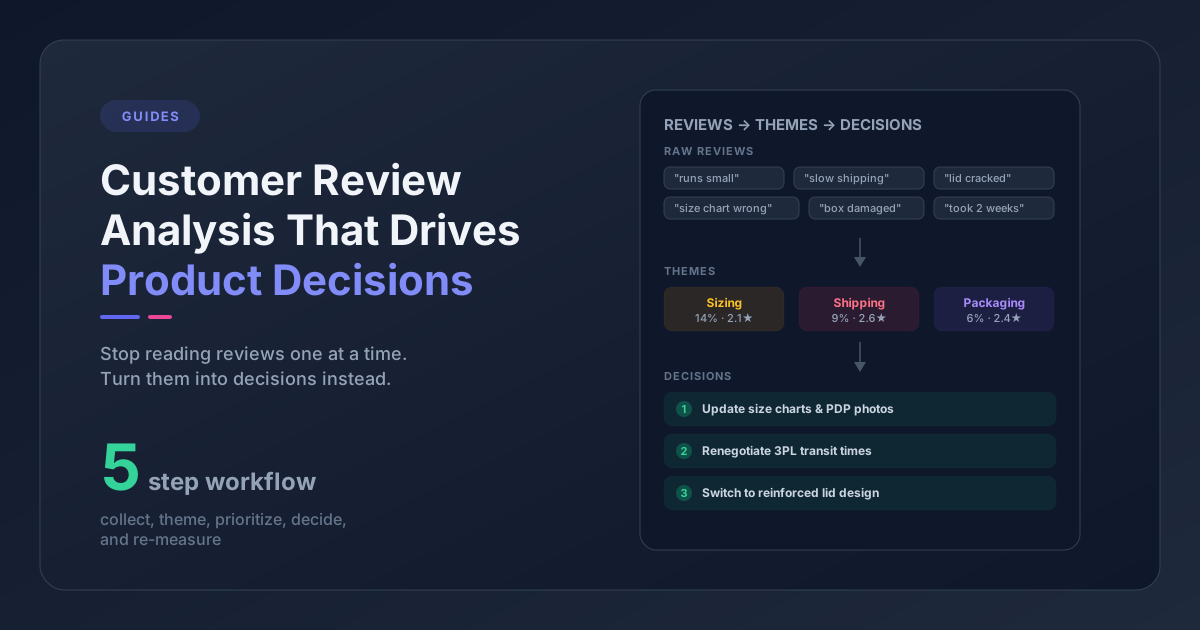
This is the most common and most valuable pattern type. Customers describe the same issue using different words. One writes "the lid broke after a week." Another says "cap cracked during shipping." A third reports "the hinge snapped." These are three different reviews describing one pattern: packaging durability.
Theme clusters are hard to catch by reading reviews individually because the language varies so much. But when you group them, they often reveal product issues that affect 10-15% of customers - the kind of problem that drives returns and kills repeat purchase rates.
Sentiment Shifts Over Time
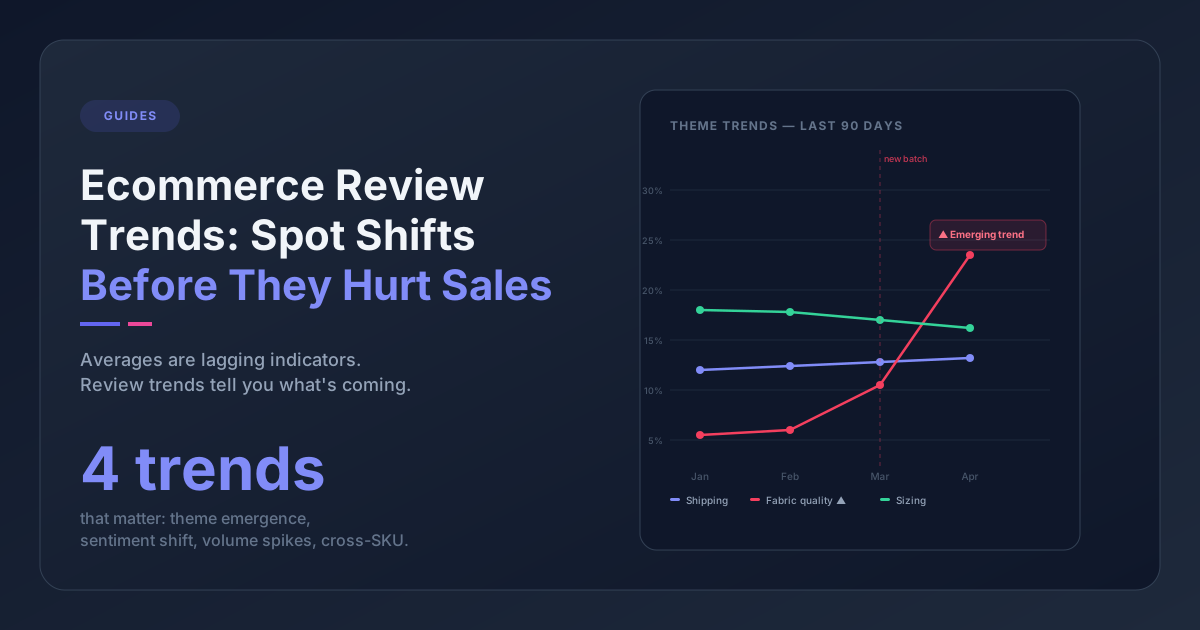
Patterns don't just exist in space - they exist in time. A product that averaged 4.5 stars for six months suddenly drops to 3.8. Reading the recent reviews individually might turn up some complaints, but the pattern only becomes clear when you track themes across time periods.
Sentiment shifts frequently correlate with operational changes: a new supplier, a packaging redesign, a change in fulfillment partner. Spotting the timing helps you identify the cause.
Product-Specific vs. Brand-Wide Patterns
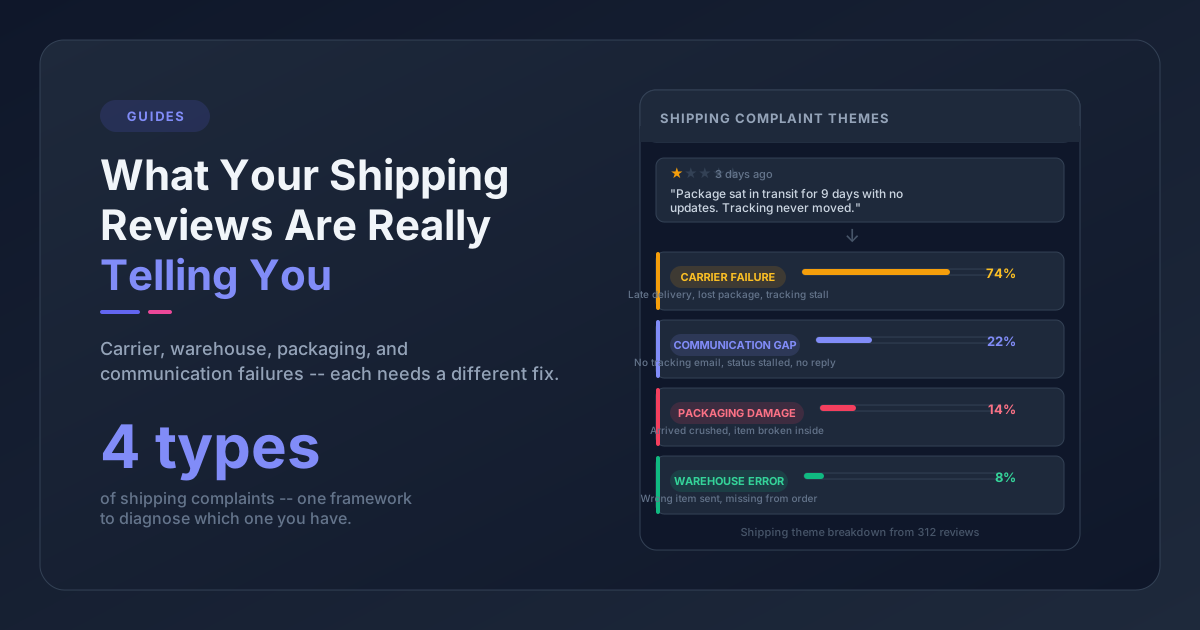
Some patterns are isolated to a single SKU (a sizing issue on one garment). Others cut across your entire catalog (slow shipping mentions appearing in reviews for every product). Distinguishing between the two determines whether the fix is a product change or an operational one.
A brand-wide pattern in shipping complaints needs a conversation with your 3PL. A product-specific fit complaint needs updated size charts or a design revision. Conflating the two wastes time and resources.
Three Ways to Spot Trends in Product Reviews
Method 1: Spreadsheet Tagging
Best for: Under 200 reviews, or when you want to deeply understand a specific product's feedback.
Export your reviews into a spreadsheet (here's our guide to formatting review CSVs if you need one). Add a "Theme" column. Read each review and assign one or two theme tags - things like "shipping speed," "material quality," "sizing," or "customer service." Keep your tag list short (10-15 categories max) to avoid fragmentation.
Once tagged, use a pivot table or simple COUNTIF formulas to see which themes dominate. Sort by star rating to see which themes correlate with low scores.
The ceiling: This works well for small datasets, but it breaks down fast. A CX manager tagging 500 reviews will spend 8-10 hours on a task that needs repeating every time new reviews come in. It's also subjective - two people will tag the same review differently about 30% of the time.
Method 2: Keyword and Phrase Frequency
Best for: 200-1,000 reviews where you want quick directional insights without reading everything.
Instead of reading every review, search for patterns computationally. Export your reviews and use a tool (even a basic word frequency counter) to identify the most common two-word and three-word phrases. "Shipping time," "customer service," "size chart" - these bigrams and trigrams point you toward the dominant themes.
You can also do targeted searches. If you suspect a quality issue, search for words like "broke," "defective," "fell apart," "cheaply made," and tally the results across products.
The ceiling: Keyword frequency misses synonyms and context. A search for "broke" catches "the clasp broke" but misses "stopped working after a month." It also can't distinguish sentiment - "great customer service" and "terrible customer service" both contain "customer service." You'll get directional insights, but you'll miss nuance.
Method 3: Customer Review Theme Extraction With AI
Best for: 500+ reviews, multiple products, or any team that needs to track patterns over time without manual effort.
Modern NLP tools group reviews by semantic meaning, not just keywords. They recognize that "runs small," "ordered my usual size and it was tight," and "definitely size up" all describe the same theme - even though they share almost no words.
This is where review analysis becomes genuinely scalable. AI theme extraction can process thousands of reviews in minutes, identify theme clusters automatically, and track how those themes shift across time periods and products. Tools like Pattern Owl do this specifically for e-commerce brands, connecting directly to review platforms like Judge.me, Yotpo, and RaveCapture and pulling out patterns across your entire catalog - no CSV exports required.
The key advantage isn't just speed - it's consistency. An AI model applies the same classification logic to every review, eliminating the subjectivity problem that plagues manual tagging.
What to Do Once You Find a Pattern
Finding patterns is step one. Acting on them is where the payoff actually happens.
Prioritize by volume and severity. A theme that appears in 2% of reviews is noise. A theme that appears in 15% of reviews and correlates with 1-2 star ratings is a fire. Multiply the frequency by the severity (how much it drags down ratings) to create a simple priority score.
Route to the right team. Pattern analysis is only useful if the insights reach the people who can act on them. Product quality themes go to your product team. Shipping and fulfillment themes go to operations. Sizing and fit themes might need both a product update and a content update (better size charts, updated product descriptions).
Track resolution over time. After making a change, monitor whether the pattern persists, improves, or shifts. If you updated your size chart for a product with fit complaints, you should see "sizing" theme mentions decrease in reviews posted after the change. If they don't, the fix didn't work.
Cross-reference with support data. Reviews tell you what customers think about your product. Support tickets tell you what went wrong enough that they contacted you about it. When the same theme appears in both channels - say, "packaging damage" shows up in reviews and in support tickets about replacements - you can be much more confident it's a real pattern worth prioritizing.
Common Mistakes in Review Pattern Analysis
Even experienced CX teams fall into a few traps.
Recency bias. It's natural to pay more attention to the last 50 reviews. But recent reviews are a sample, not the full picture. A complaint that appeared three times last week might appear in 0.5% of all reviews over six months. Always analyze patterns across a meaningful time window - 90 days minimum for most products.
Ignoring neutral reviews. Three-star reviews are the most analytically valuable reviews you have. Five-star reviews tend to be vague ("Love it!"). One-star reviews tend to be emotional. But three-star reviews describe specific trade-offs: "The quality is great, but the sizing runs small" or "Fast shipping, though the packaging could be better." If you're only analyzing negative reviews, you're missing half the useful detail.
Treating all products equally. A product with 50 reviews needs a different analysis threshold than one with 2,000. A theme appearing in 5 out of 50 reviews (10%) is potentially significant. The same theme appearing in 5 out of 2,000 reviews (0.25%) is statistical noise. Set your significance thresholds relative to each product's review volume.
Frequently Asked Questions
How many reviews do I need before patterns are meaningful?
You need at least 50 reviews per product to start identifying reliable patterns. Below that threshold, individual outliers distort the data too much. For brand-wide patterns across multiple products, aim for 200+ total reviews.
Can AI categorize reviews better than a human?
AI theme extraction is more consistent than manual tagging - it applies the same classification logic to every review without fatigue or subjectivity. Humans are better at catching nuance in a single review, but AI wins at scale: processing thousands of reviews in minutes while keeping categorization consistent across the entire dataset.
What's the difference between sentiment analysis and theme extraction?
Sentiment analysis tells you whether a review is positive, negative, or neutral. Theme extraction tells you what the review is about - shipping speed, material quality, sizing, packaging. Theme extraction is more useful for product decisions because it tells you specifically what to fix, not just that something is wrong.
How often should I re-analyze my review patterns?
For most ecommerce brands, a monthly review is enough. If you're launching new products or making operational changes (new supplier, new 3PL), analyze weekly to catch shifts early. Automated tools can track themes continuously so you always have current data.
Getting Started Today
You don't need a sophisticated toolchain to start finding patterns. Here's the simplest path:
- Pick your highest-volume product. Start where you have the most data.
- Export the last 90 days of reviews. Whether from Shopify, Judge.me, Yotpo, or wherever they live.
- Tag 100 reviews manually. Yes, manually. Even if you plan to automate later, manually tagging a sample teaches you what patterns exist in your data and gives you a baseline to validate automated results against.
- Look for the top three themes. Which categories appeared most often? Which ones correlated with the lowest ratings?
- Ask one question about each pattern. "Do we already know about this? Is anyone working on it? What would fixing it do to our return rate?"
That exercise alone - maybe two hours of work - will almost certainly reveal at least one pattern your team didn't know existed.
The goal isn't to read every review. It's to know what your reviews are telling you at scale so you can make better product and CX decisions faster. Whether you start with a spreadsheet or an AI tool, the shift is the same: stop treating reviews as individual data points and start treating them as a dataset.