You're staring at another shipping complaint in your customer reviews: "Terrible shipping. Never ordering again." Your CX team apologizes, issues a partial refund, and moves on. Two months later you've got 80 more that read almost identically, and your shipping average has slid to 2.4 stars. The refund handled the customer. Nothing handled the cause.
The problem isn't that you're ignoring shipping complaints. It's that you're treating all of them the same when they're not.
Shipping feedback is the category most teams read wrong, because it looks like one problem when it's actually four. Stores with strong logistics processes see shipping-related complaints in 5-10% of reviews -- above 15-20% is a signal that something systemic needs attention. But the volume number is only the start; the type of complaint determines the fix. A package that arrives late because your carrier had a regional delay needs a completely different response than a package that arrives late because your warehouse took five days to pick it.
Most brands respond to all shipping complaints with the same script. The result: the complaints keep coming, the root cause never changes, and your shipping reputation slowly erodes.
Why Shipping Is the Hardest Customer Feedback to Act On
Shipping complaints have four or five hands on them before the customer ever writes the review. Your inventory system released it, your warehouse picked and packed it, the carrier scanned it (maybe), a local delivery contractor dropped it. Any one of those can be the failure point.
But the review you read says something like: "Order was a nightmare. Took forever, box was destroyed, no one would tell me where it was." That's three different customer feedback shipping problems in one sentence - carrier delay, packaging damage, and tracking failure - and your reply will only address whichever one you assume is dominant.
This is why the "apologize and refund" response is so common. It resolves the individual complaint. But it tells you nothing about which step in your shipping chain is failing, or how often.
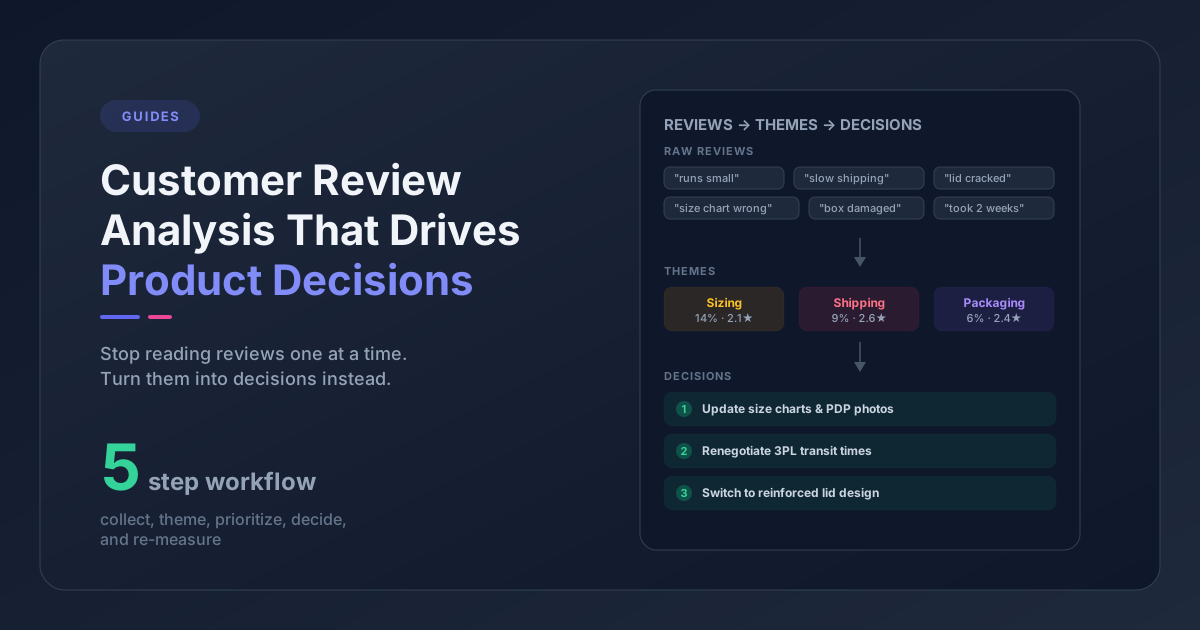
The teams that actually reduce their shipping complaint volume do one thing differently: they categorize complaints by category before responding - and shipping is the category where that discipline matters most.
The Four Types of Shipping Complaints
Every shipping complaint your customers write falls into one of four categories. These four shipping review categories - carrier, warehouse, packaging, and communication - each have a distinct root cause and a distinct fix.
| Category | Customer language | Root cause | Where to verify |
|---|---|---|---|
| Carrier failures | "Late," "lost," "stuck in transit" | Carrier network | On-time delivery rate vs. SLA |
| Warehouse errors | "Wrong item," "missing," "took forever" | Pick/pack/ship process | Order-to-ship timeline by SKU |
| Packaging failures | "Smashed," "broken," "rattling" | Spec or carrier handling | Damage rate by carrier and SKU |
| Communication failures | "No tracking," "no update," "no reply" | Transactional emails or tracking page | WISMO ticket volume |
1. Carrier Failures
What customers say: "Arrived 10 days late," "package was lost," "shows delivered but wasn't," "stuck in transit for two weeks," "left at the wrong door."
What's actually happening: Your carrier network had a service failure: missed scans, routing errors, lost packages, or inaccurate delivery confirmations.
How to verify: Cross-reference the complaints against your carrier's on-time delivery data for the same period. If your complaint spike aligns with a specific date range, zip code cluster, or service level (ground vs. priority), you're looking at a carrier issue.
Check whether complaints are concentrated on one carrier or distributed across all of them. Concentration is a carrier problem. Distribution suggests something in your own process is causing delays before the package even gets to the carrier.
What to do:
- Pull your carrier's on-time delivery rate and compare it against your contract SLA
- File carrier claims for lost packages systematically. This creates a paper trail and signals volume issues to your account rep
- If a carrier consistently underperforms a specific route, negotiate a service credit or add a backup carrier for that region
- Communicate proactively with customers when you know there's a regional delay. A heads-up email before the complaint arrives converts an angry review into a neutral one
2. Warehouse and Fulfillment Errors
What customers say: "Wrong item sent," "missing items from my order," "they shipped to my old address," "took forever to ship even though it said in stock," "order was never processed."
What's actually happening: Something went wrong in your pick, pack, or ship process, before the carrier ever touched the package.
How to verify: Look for complaints that describe fulfillment problems specifically: wrong SKU, wrong quantity, wrong address, or long delays between order and ship date. Pull your average fulfillment time (order to ship) by product and date range. If your shipping complaint spike coincides with a fulfillment time spike, the problem is warehouse-side.
Check whether errors are concentrated on specific products or SKUs. High-complexity SKUs (multiple variants, bundle packs) generate more pick errors than simple single-SKU orders.
What to do:
- Audit your pick-and-pack error rate by product type and SKU complexity
- If you're using a 3PL, compare their reported error rate against your review data. They often track metrics that never reach you
- For wrong-item complaints: review whether your SKU codes are visually distinct enough in the warehouse. Similar-looking products stored adjacent to each other are a common source of pick errors
- For slow ship times: map your order-to-ship timeline by day of week, time of day, and order volume. Staffing gaps and volume spikes are usually the cause
3. Packaging Failures
What customers say: "Arrived completely smashed," "box was destroyed," "item was broken inside," "everything was rattling around," "terrible packaging - clearly just thrown in a bag."
What's actually happening: Your packaging isn't surviving the handling your carrier puts it through. This can be a packaging spec problem, a carrier handling problem, or both.
How to verify: Packaging damage complaints that are evenly distributed across carriers usually point to your packaging spec. Complaints concentrated on one carrier, or on packages that went through a specific hub, point to handling. Check your carrier's damage claims history - they track this separately from delivery performance.
Also look at product-level concentration. A specific SKU generating disproportionate damage complaints usually has a fragile component that isn't getting adequate protection for its size and weight class.
What to do:
- Order your own products as a mystery shop and inspect the packaging on arrival. Your ops team sees the box before it's been handled; you need to see it after
- Review your package dimensions vs. product weight. Over-large boxes with insufficient fill create more internal movement and damage
- If a specific SKU is generating damage complaints, test a packaging upgrade (more fill, double-walled box, custom insert) and track whether the complaint rate drops
- Negotiate damage claim credits with your carrier. Even if they don't own the root cause, systematic claims data prompts their packaging engineering team to flag your account for handling guidelines
4. Communication and Tracking Failures
What customers say: "No tracking email," "says delivered but I was home all day," "tracking hasn't updated in a week," "got no shipping confirmation," "your customer service had no idea where my order was."
What's actually happening: The logistics experience is opaque to the customer. They're not getting the information they need to feel confident their order is on the way.
Why this matters separately: Communication failures often generate reviews even when the order arrives fine. A customer who got no tracking email, watched the status stall for five days, sent three emails to your support team, and then received the package in perfect condition - is still writing a one-star review. The product was fine; the experience was terrible.
How to verify: Look for complaints where the package apparently arrived but the customer describes anxiety, confusion, or repeated contact attempts. These are communication failures, not delivery failures. Cross-reference with your support ticket volume: a spike in "where is my order?" tickets is the leading indicator, before the reviews hit. High WISMO ticket volume is also a strong signal to reduce support tickets through proactive communication.
What to do:
- Audit your transactional email triggers: does every customer get a shipping confirmation with a working tracking link? Do they get an update when the package is out for delivery?
- Check your tracking page. Many stores use carrier-generated tracking pages that break for certain carriers, routes, or service levels
- If tracking stalls legitimately (packages in transit don't always scan daily), build a proactive "your package is on its way" email that fires after a set period with no scan event, to preempt the anxiety spiral
- Train your support team to give confident, specific answers when customers ask about tracking. "I can see it's in transit with FedEx and expected by Tuesday" is far more reassuring than "let me look into that for you"
How to Analyze Shipping Complaints in Customer Reviews
Read shipping reviews for the pattern, not the individual complaint. Here's the sequence.
Step 1: Separate shipping complaints from all other feedback. Pull every review and support ticket that mentions shipping, delivery, packaging, tracking, or fulfillment. Don't try to analyze shipping feedback mixed into a general queue; volume comparisons don't work that way. The methods for finding patterns in customer reviews apply here too - you need enough volume to spot a cluster, not just a single complaint.
Step 2: Look at the language. Effective shipping review analysis isn't about reading every complaint - it's about clustering language patterns at scale. "Late," "delayed," "stuck in transit" - carrier failure cluster. "Wrong," "missing," "didn't process" - warehouse cluster. "Smashed," "broken," "damaged," "rattling" - packaging cluster. "No update," "no tracking," "no confirmation," "couldn't get an answer" - communication cluster.
Step 3: Look for timing patterns. Did your shipping complaints spike after a specific date? A carrier switch? A new warehouse? A product launch? Timing patterns tell you when the problem started, which usually tells you what changed.
Step 4: Look for product or SKU concentration. If 60% of your damage complaints are about one product line, the problem is specific to that SKU's packaging or fragility - not your shipping process broadly. If complaints are distributed evenly across your catalog, the problem is systemic. Once you've spotted the pattern, you can trace the complaint to its root cause upstream.
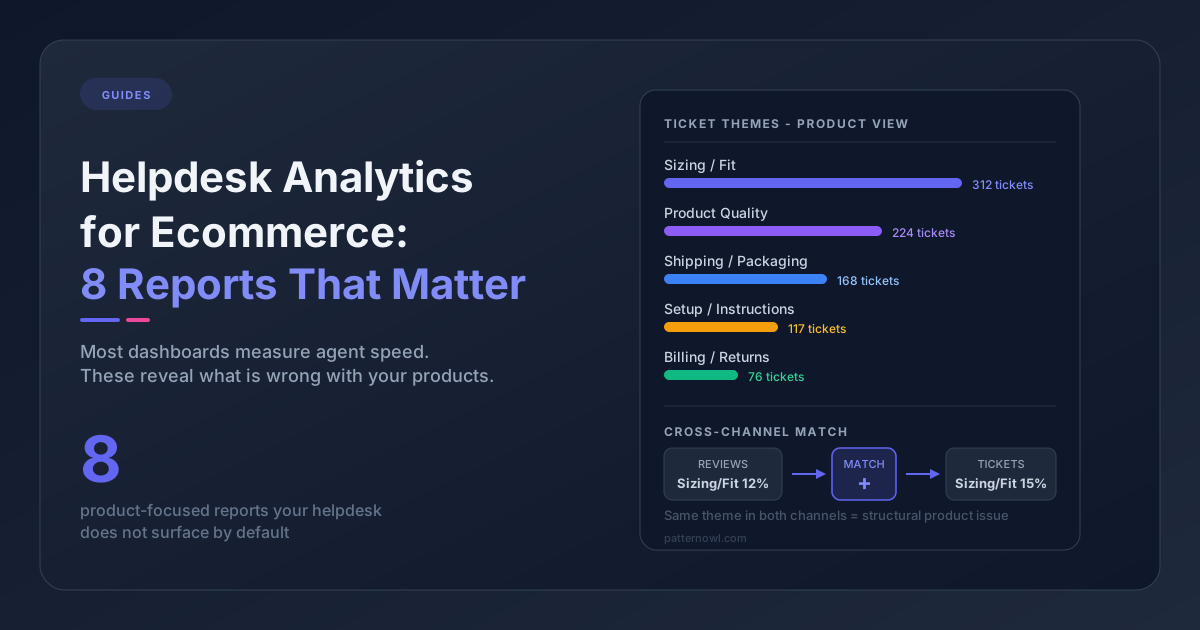
Step 5: Cross-reference reviews with support tickets. Reviews are often too short to diagnose from. Support tickets are richer: customers describe the problem, attach photos, answer questions. Combining both sources gives you better pattern data, especially for damage and wrong-item complaints where photos in tickets reveal what reviews don't.
When you analyze reviews and support tickets together, support tickets reveal the mechanism of the complaint and reviews reveal the scale.
How to Reduce Shipping Complaints (and Verify the Fix Is Working)
Once you've identified the complaint type and made a change (new carrier SLA, updated packaging spec, new tracking email trigger), you need to verify that the fix actually reduced the complaint volume.
Here's a concrete action sequence:
- Pull last 90 days of shipping-related reviews and support tickets. Tag each by the four categories above.
- Identify the dominant category. That's your first priority.
- For carrier-dominant: pull on-time delivery data by service level and route. File claims systematically.
- For warehouse-dominant: audit your pick-pack error rate. Map it by SKU complexity and shift schedule.
- For packaging-dominant: order your own products as a mystery shop. Check damage rate by carrier.
- For communication-dominant: test every transactional email trigger. Audit tracking page rendering across carriers.
Watch for feedback lag. Reviews and tickets trail operational changes by 4-6 weeks. A customer who ordered during the problematic period will write their review 5-14 days after receiving the package. Don't chase week-over-week fluctuations. Compare your shipping complaint rate (complaints as a percentage of orders) over 30-day windows.
What to watch for:
- Complaint rate declining after your fix: you identified the right root cause and addressed it.
- Complaint rate flat after your fix: you either didn't fix the root cause, or fixed one cause but another is still active. Go back to the categorization step.
- Complaint type shifting after your fix: you fixed one category, but revealed another that was previously hidden. Classic example: fix your carrier's on-time delivery, and packaging damage complaints become visible because they were previously buried under the volume of delay complaints.
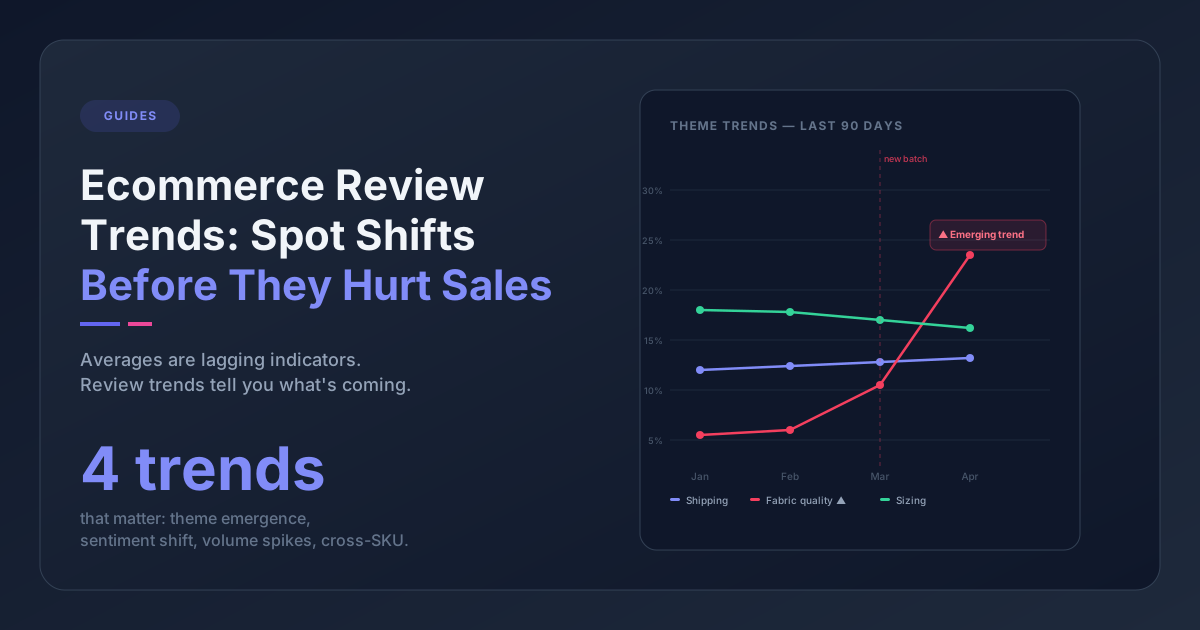
The hard part isn't reading 50 reviews once. It's noticing that "late delivery" complaints dropped while "damaged packaging" complaints quietly doubled - and acting on the second trend before it becomes the new headline. Tools like Pattern Owl detect these sub-theme shifts automatically; customer feedback analysis tools vary widely in how granular their shipping sub-theme detection is.
Shipping Complaints FAQ
Common questions about analyzing shipping complaints from customer reviews.
What is the most common shipping complaint in ecommerce reviews?
Late delivery generates the most shipping complaints by volume - more than damaged items, lost packages, wrong items, or tracking issues combined. The distribution shifts by product category: fragile goods skew toward damage complaints, apparel toward wrong-item and variant errors, and high-value products toward delivery confirmation issues.
How do I reduce shipping complaints in my ecommerce store?
Start by categorizing your shipping complaints into the four types: carrier failures, warehouse errors, packaging failures, and communication breakdowns. Each has a different root cause and a different fix. Treating all shipping complaints with the same response (apologize, refund) reduces them temporarily but doesn't address the underlying problem. The goal is to identify which type is dominant in your feedback and fix that specific part of your shipping process. See the action sequence in the section above for a step-by-step playbook.
How many shipping complaints are normal for an ecommerce store?
Benchmarks vary by category and carrier mix. Stores with strong shipping processes typically see shipping-related complaints in 5-10% of reviews. Above 15-20% is a signal that something systemic needs attention. The more useful benchmark is your own trend - is your shipping complaint rate going up, staying flat, or declining?
Should I respond to negative shipping reviews?
Yes, but the response is less important than the analysis. A polite, specific response to a negative shipping review protects your public reputation. But the real value of shipping feedback is diagnostic: what does the pattern tell you about where your shipping process is failing? Fix the process and the reviews improve automatically.
How to Use Negative Shipping Reviews as a Diagnostic Tool
Shipping complaints are not monolithic. A carrier that loses packages in winter, a warehouse that picks wrong SKUs during high-volume periods, packaging that can't survive ground shipping, and a tracking system that goes dark for five days - these all look like "shipping problems" in your review feed, but they require completely different fixes.
The discipline is in the categorization. Read your negative shipping reviews as a diagnostic system, not just a reputation score. Look for which type of complaint is dominant, look for timing and SKU patterns, and trace the complaint back to the part of your shipping chain that actually failed.
When you can reliably tell the difference between "this is a carrier problem" and "this is a warehouse problem," you stop apologizing and start fixing - and the complaint volume follows.
Pattern Owl does this shipping review analysis automatically. It reads your reviews and support tickets together, splits shipping feedback into carrier, warehouse, packaging, and communication sub-themes, and flags which one is rising week over week - so you know where to look before the volume hits your star rating.