You have hundreds of reviews sitting across Judge.me, Yotpo, or your Shopify admin right now. Your support team fields dozens of tickets a week through Gorgias or eDesk. And if your operation is like most ecommerce brands, someone skims the angry reviews when they have time, the support team resolves tickets one by one, and nobody is looking at what all that feedback says when you read it together. The cost of ignoring customer feedback is higher than most brands realize.
It's not the occasional bad review. It's the patterns hiding in your data that nobody is connecting - the sizing issue driving returns on your best-seller, the packaging problem generating replacements you're eating the cost on, the product request buried in 200 five-star reviews that could be your next SKU.
Those patterns are already in your data. The question is how much you're paying by not seeing them.
Five Hidden Costs of Ignoring Customer Feedback
Repeat Returns From the Same Defect
An apparel brand has a jacket with a 4.3-star average. Looks fine. But scattered across months of reviews, 18% of customers mention it runs large. Some write "runs a full size big." Others say "had to exchange for a smaller size." A few just note they "wouldn't buy their usual size again."
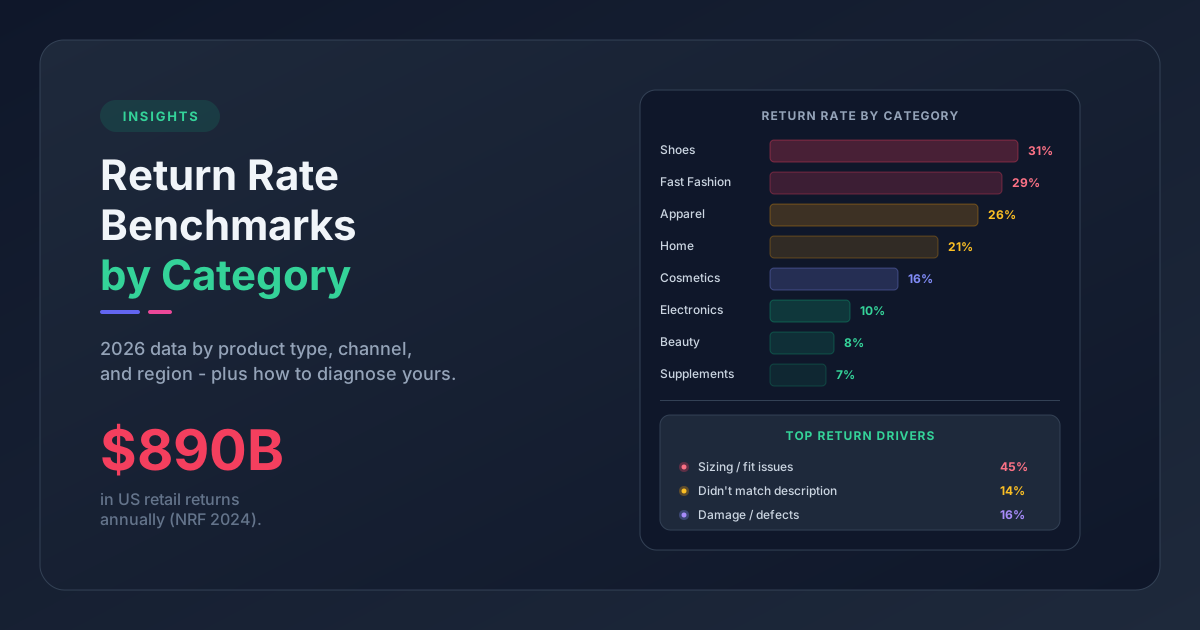
No single review raises an alarm. The star rating barely moves. But that 18% translates directly into return shipping costs, warehouse processing, and restocking labor. The National Retail Federation reports that return processing costs retailers an average of $21-$46 per item, depending on the category.
If that jacket sells 500 units and 18% generate a return over a sizing issue that could be fixed with an updated size chart or a product description note - that's 90 preventable returns. At even $20 each, you're looking at $1,800 in avoidable costs on a single product. Multiply across your catalog and sizing, material, and color-accuracy issues add up fast.
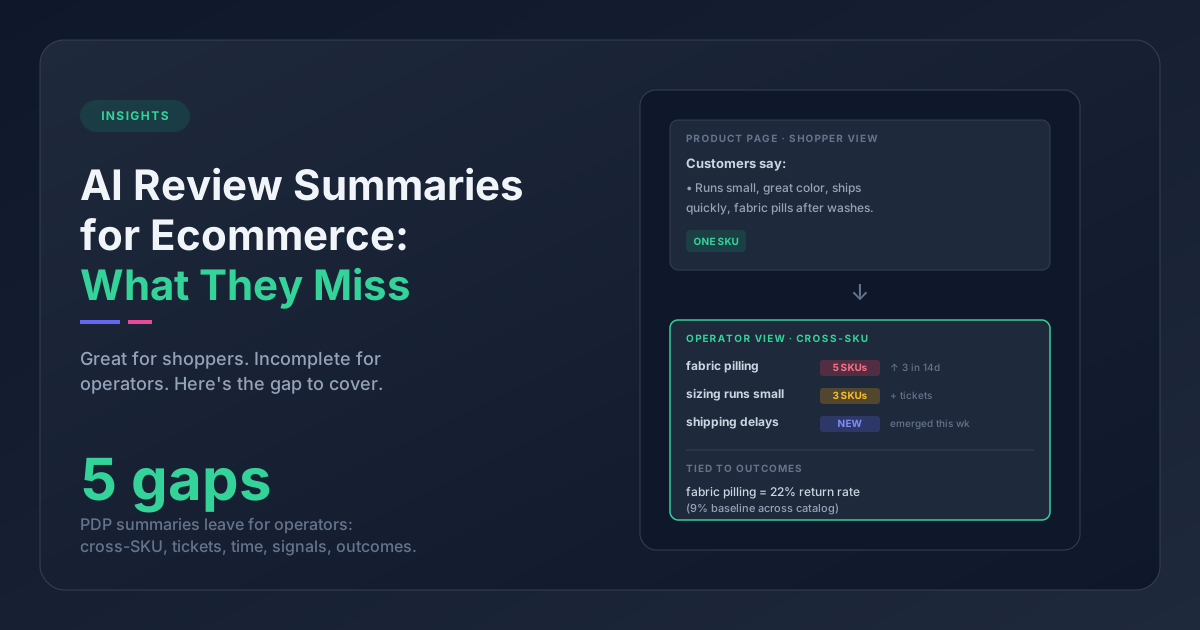
The frustrating part: the data was there. It just wasn't aggregated. Reading reviews one at a time catches individual complaints. Only pattern analysis catches the theme.
Wasted Product Development Budget
Your customers are already telling you what to build next. The problem is where they put the request - inside five-star reviews.
"Love this protein powder - wish it came in single-serve packets for travel."
"Perfect daily moisturizer. Would buy the SPF version immediately."
These aren't complaints. They're product ideas from your most loyal customers, delivered for free. But most teams categorize five-star reviews as "positive" and move on. When nobody reads between the stars, those requests disappear under the next batch of reviews.
Meanwhile, your product team is guessing what to develop next - or worse, building based on competitor moves instead of customer demand. Every dollar spent developing a variant nobody asked for is a dollar not spent on the capsule form that 12% of your customers specifically requested.
Customer Churn Disguised as Competition
When a repeat customer stops buying, most brands assume they found a competitor. Sometimes that's true. But more often, the customer hit a problem your team already knew about - they just didn't realize it was driving people away.
Here's how it plays out: a customer buys a skincare product and loves it. Three months later, the pump mechanism breaks. They submit a support ticket, get a replacement, and move on. Six months later, it breaks again. This time they don't bother contacting support. They just buy from someone else.
Your analytics show a lost customer. Your review data shows a 4.5-star product. But your support ticket data shows a pattern of mechanical failures across dozens of customers - and nobody's reading both channels together. The churn wasn't about a competitor having a better moisturizer. It was about a $0.30 pump that keeps breaking - and nobody noticed the pattern.
Acquiring a new customer costs five to seven times more than retaining an existing one. Every customer lost to an unresolved pattern costs you the full replacement acquisition price.
Ad Spend Driving Traffic Into a Known Problem
This is the one that really stings. You're spending $3-5 per click to drive traffic to a product page where 12% of reviews mention the packaging arrived damaged. Every ad dollar is buying you a new customer who has a meaningful chance of receiving a damaged product, submitting a support ticket, and potentially leaving a negative review that makes the next customer even harder to convert.
You're not just losing the cost of the return. You're paying to create more returns.
A pet food brand running ads on a product where customers frequently report "bag arrived open" or "kibble was stale on arrival" is essentially funding their own negative review pipeline. The fix might be a packaging change or a conversation with your fulfillment partner - but without reading the reviews and tickets together, nobody connects the ad spend to the packaging complaints to the return rate.
Your Competitors Can Read Your Reviews Too
Your reviews are public. Every competitor in your space can read them. The question is whether they're analyzing them more systematically than you are.
A competitor who notices that your top-selling supplement has 15% of reviews mentioning "chalky texture" can develop a smoother formula and market directly against your weakness. They don't need insider information. They just need to find the patterns in your public feedback that you're not acting on.
Here's the asymmetry: you have access to both your reviews and your support tickets. Your competitors only see the reviews. That private support data is your edge - but only if you're using it to improve your products. When you ignore both channels, you're giving competitors the same information advantage over you that you should have over them.
The Manual Analysis Tax
Even brands that try to analyze their feedback often underestimate the cost of doing it manually.
A CX manager spending one hour per day reading and categorizing reviews - a modest estimate for a brand with 50+ reviews coming in weekly - represents roughly $12,000 in annual labor cost at a mid-range salary. That hour catches individual issues but misses the patterns that tell you which product to fix first.
Manual tagging also breaks down in ways that aren't obvious at first. Two people will categorize the same review differently about 30% of the time. "Runs small" and "I ordered my usual size and it was tight" describe the same theme, but a keyword search for "runs small" misses the second one entirely. And the moment you fall behind on tagging - a busy holiday season, a product launch, a team member leaving - your analysis gap widens.
The alternative isn't "don't analyze." It's to stop doing manually what can be done systematically. Whether that's a more structured spreadsheet process, keyword frequency tools, or AI-powered theme extraction, the goal is the same: get the patterns out of your data without burning hours that could go toward acting on those patterns instead.
How to Calculate Your Ecommerce Customer Feedback ROI
If you're trying to justify investing time or budget in feedback analysis, here's a simple framework:
Cost side:
- Time spent on manual review reading (hours/week x hourly cost x 52)
- Returns driven by issues visible in review data but not currently tracked
- Support ticket volume for problems that could be prevented with product changes
- Ad spend on products with known, unresolved feedback issues
Value side:
- Return rate reduction from fixing the top 2-3 themes in your review data
- Fewer repeat tickets once you fix the underlying product issues
- Better product development accuracy from using customer review data to guide product improvements
- Better retention from actually fixing the problems customers keep reporting
Most brands find that fixing even one major theme - a sizing issue, a packaging problem, a misleading product description - pays for the entire analysis effort several times over. At scale, tools like Pattern Owl show you the top themes across thousands of reviews and tickets in minutes - the patterns you'd never catch reading one by one. But even a spreadsheet tracking themes for your top five products will show you something worth fixing.
Frequently Asked Questions
How much does ignoring customer feedback cost an ecommerce brand?
The cost varies by catalog size and volume, but common cost centers include preventable returns ($20-46 per return in processing costs), wasted product development on features nobody requested, increased customer acquisition costs from churn driven by unresolved issues, and ad spend directed at products with known problems. For a mid-size brand doing $1-5M in annual revenue, unanalyzed feedback patterns can easily represent $20,000-$50,000 in avoidable costs per year.
What's the fastest way to start analyzing customer feedback?
Start with your highest-volume product. Export the last 90 days of reviews - from Shopify, BigCommerce, WooCommerce, or whatever platform you're on - and tag recurring themes in a spreadsheet. Focus on 3-4 star reviews first, since they contain the most specific detail. Look for the top three themes by frequency and check whether your support tickets show the same patterns. That exercise alone usually reveals at least one problem your team didn't know existed.
How do you measure the ROI of customer feedback analysis?
Track three metrics before and after you start systematic analysis: return rate on products where you fixed a feedback-identified issue, support ticket volume for recurring themes you've addressed, and repeat purchase rate for customers who previously experienced the resolved issue. The most direct measure is return rate reduction - if fixing a sizing issue on a single product drops returns by even 5%, the math usually justifies the analysis investment on that product alone.
The Data Is Already There. Nobody's Reading It.
The data isn't the problem. Every ecommerce brand with a review platform and a helpdesk already has the raw material for better product decisions, lower return rates, and improved retention.
The gap is between collection and action. Reviews pile up. Tickets get resolved individually. And the patterns that connect them - the themes that explain why returns are climbing, why a product isn't getting reorders, why support costs are creeping up - sit in the data unnoticed.
You don't need more feedback. You need to start treating the feedback you have as a dataset, not a to-do list. Whether you start with a structured voice of customer program, a spreadsheet tagging your top product's reviews, or an automated tool that does it at scale - the shift is the same. Stop reading reviews one at a time. Start asking what they're telling you together.
Want to see what patterns are hiding in your reviews? Try Pattern Owl free - connect your review platform and get your first analysis in under 10 minutes.