Somewhere in your reviews right now, a customer is describing a product defect you don't know about yet. Not in a support ticket. Not in a return reason dropdown. In a 3-star review that says "love the design but the zipper broke after a week."
If you want to detect product issues from customer reviews before they turn into return spikes and rating drops, you need a system for reading reviews as product data - not just customer feedback to respond to. Sentiment drift on a specific product is usually the earliest signal a defect is brewing.
The problem isn't that the information doesn't exist. It's that product issues show up across dozens of individual reviews, described in slightly different language each time, and nobody is connecting the dots. By the time a quality problem shows up in your return rate data, you've already shipped hundreds of defective units and lost customers who won't come back.
Why Product Issues Hide in Plain Sight
Most ecommerce teams treat reviews as a customer service channel. Someone reads them, writes responses, maybe escalates the angry ones. But nobody is systematically watching for product-level patterns.
Here's why issues slip through:
Star ratings move too slowly. A product can accumulate 15 complaints about a specific defect while its average rating only drops from 4.2 to 4.1. Star ratings alone hide the signal because they compress a detailed complaint into a single number.
Complaints are scattered across time. Five reviews mentioning "stitching came apart" over six weeks looks like five isolated incidents when you read reviews chronologically. It's only a pattern when you group by product and complaint type.
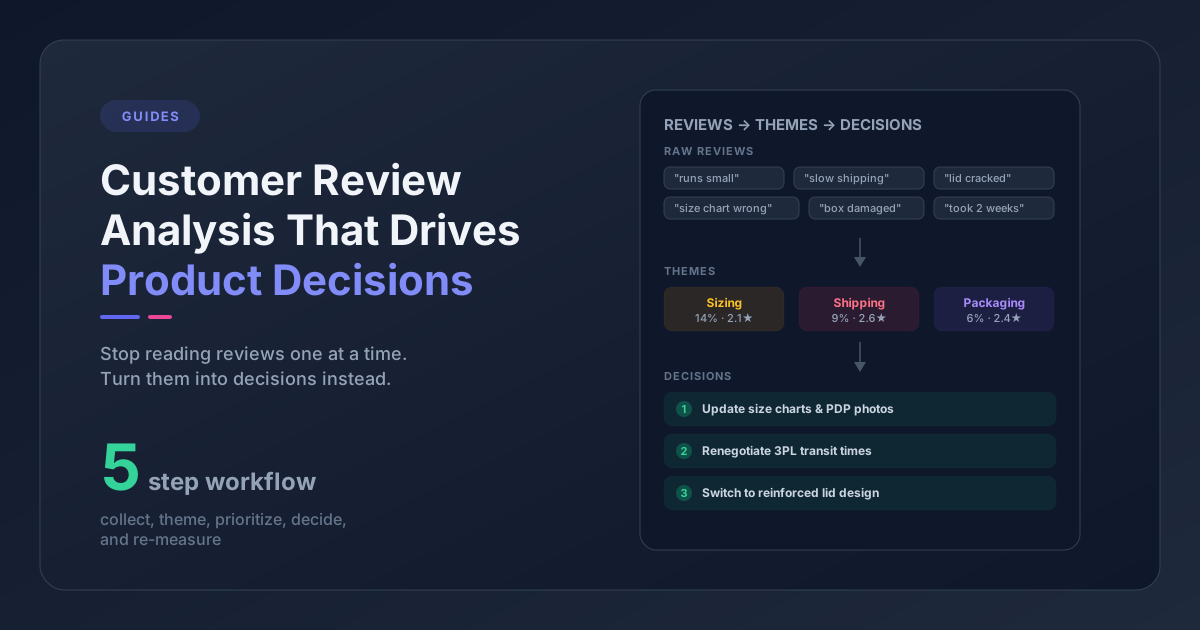
Different words, same problem. "Runs small," "order a size up," "tight in the chest," "sizing is way off," and "not true to size" are all the same issue. Simple keyword searches miss at least half of them because customers describe problems in their own language.
Reviews live in one silo, support tickets in another. A customer who emails about a broken zipper and a customer who leaves a 2-star review about the same zipper are reporting the same defect through different channels. If your CX team and your product team aren't looking at both sources together, each channel looks like a smaller problem than it actually is.
The result: product issues that could be caught in weeks go undetected for months. By then, the damage is done - returns have spiked, ratings have dropped, and you've lost customers who never told you why.
What Product Issues Look Like in Review Text
Before you can detect issues, you need to know what you're looking for. Product problems in reviews tend to fall into five categories, each with distinct language patterns:
| Issue Type | What Customers Write | What It Means |
|---|---|---|
| Quality defect | "Broke after a week," "stitching came apart," "stopped working," "paint chipped" | Manufacturing or materials problem - talk to your supplier |
| Sizing/fit | "Runs small," "way bigger than expected," "doesn't match the size chart" | Pattern/mold issue or inaccurate size guide |
| Expectation mismatch | "Looks nothing like the photo," "color is completely different," "smaller than pictured" | Product listing problem - photos or description are misleading |
| Durability | "Fell apart after a month," "quality dropped from last time," "doesn't hold up" | Materials downgrade or supplier change |
| Missing information | "Didn't know it needed batteries," "wish I'd known it was hand-wash only" | Product description gaps |
The five most common product issues found in reviews are quality defects, sizing and fit problems, expectation mismatches, durability concerns, and missing product information.
The tricky part: customers rarely use these neat categories. A review that says "love the color but it faded after two washes" is both a quality signal and a durability signal. A review saying "beautiful bag but the strap broke on day three" combines praise with a defect report.
That's why reading individual reviews isn't enough. You need to extract the complaint patterns and group them to see what's actually happening at the product level.
How to Detect Product Issues From Customer Reviews
Here's a step-by-step system that works whether you have 50 reviews or 5,000.
Step 1: Set a Review Monitoring Cadence
Most teams read reviews reactively - when a customer complains loudly enough, or when someone happens to check. That's not detection. That's luck.
Set a regular cadence instead:
- New product launches: Read every review for the first 30 days. This is your highest-risk window - manufacturing problems, sizing errors, and description inaccuracies show up fast.
- Established products: Review the last 2 weeks of feedback every Monday. You're watching for new patterns and changes in existing ones.
- Post-change monitoring: Updated a product, switched a supplier, or changed a listing? Read every review for 2 weeks after the change to see if it helped or made things worse.
The cadence matters more than the exact schedule. A team that reads reviews every Monday catches problems weeks earlier than a team that checks "when they get around to it."
Step 2: Group Complaints by Product, Not by Date
This is the single most important shift. When you read reviews in chronological order across your whole store, patterns are invisible. When you read reviews grouped by product, they jump out.
Pull up the last 30-50 reviews for a specific product. Read only the negative and mixed ones (1-3 stars). Write down each complaint in a few words. Now count them.
You'll often find something like:
- "Runs small" - 8 mentions
- "Color different from photo" - 4 mentions
- "Zipper quality" - 3 mentions
- Everything else - scattered one-offs
That product doesn't have a "review problem." It has a sizing problem and a photography problem. Those are fixable. This product-by-product approach is the foundation of effective issue detection in ecommerce reviews.
Step 3: Watch for Velocity, Not Just Volume
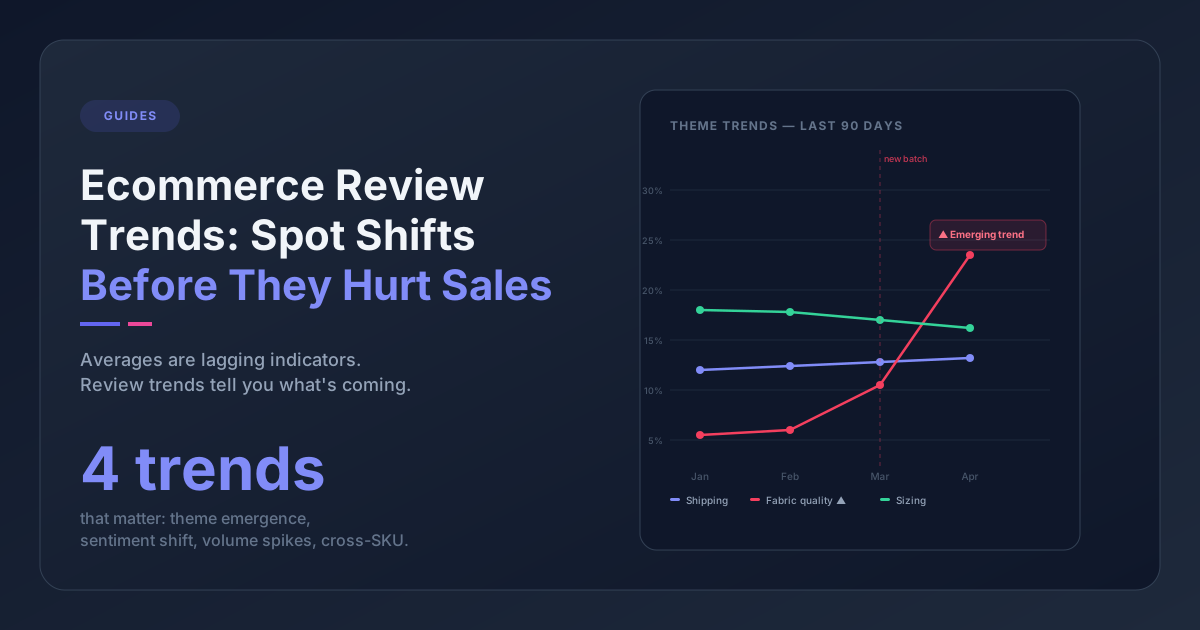
Five complaints about stitching quality over six months is background noise. Five complaints about stitching quality in the last two weeks is a signal that something changed.
Velocity tells you different things than volume:
- Sudden spike in a specific complaint: Something changed. New batch from the supplier? New sizing run? Seasonal material variation?
- Gradual increase: The problem has always been there but is getting worse - possibly because review volume is growing and the defect rate is constant.
- New complaint type appearing: If a product that never had "material quality" complaints suddenly starts getting them, your supplier may have made a substitution.
This is where review data becomes an early warning system for ecommerce teams - catching problems weeks before they show up in return rates. Support tickets often show the same patterns even earlier, since frustrated customers tend to contact support before leaving a review.
Step 4: Cross-Reference With Support Tickets
Reviews and support tickets are two views of the same customer experience. A sizing issue that generates 10 reviews probably also generates 20 support tickets asking "what size should I order?" and 15 returns filed as "didn't fit."
When you combine both channels, you get:
- More accurate counts. The real scope of a problem is the review complaints + the support tickets + the silent returns. Reviews alone undercount every issue.
- Faster detection. Customers who contact support tend to do it sooner than customers who leave reviews. Support ticket spikes often lead review complaint spikes by 1-2 weeks.
- Richer context. Reviews are short. Support conversations are detailed. A review might say "wrong color." The support thread explains exactly how the navy blue looks teal under certain lighting.
Step 5: Set Thresholds That Trigger Action
Not every complaint requires a response. But you need clear thresholds that turn a pattern into an action item. Without them, you'll just have a list of complaints that nobody acts on.
A reasonable starting framework:
- 3+ mentions of the same issue for products with under 50 reviews: investigate
- 5+ mentions for products with 50-200 reviews: flag for the relevant team
- More than 5% of reviews mentioning the same complaint: this is a confirmed product issue, not a one-off
The threshold should also account for business impact. Three complaints about a defect on your bestseller are worth investigating immediately. Three complaints on a low-volume SKU can wait for the next review cycle.
Building an Early Warning System
Product quality monitoring through reviews doesn't have to be complicated. The steps above work manually for a handful of products. But if you sell dozens or hundreds of SKUs, you need something more structured.
The manual version is a spreadsheet with columns for product, complaint theme, count, first detected date, and status (watching / flagged / fixed). Update it weekly during your review monitoring cadence. It's not glamorous, but it works for stores with under 100 active products.
The automated version uses AI to automate the pattern extraction continuously. Tools like Pattern Owl pull themes from reviews and support tickets automatically, so you see complaint clusters by product without manually reading every review. The detection happens across both channels at once, which catches issues the manual approach misses.
Either way, the principle is the same: you're building a system that turns individual complaints into aggregated, product-level signals.
Consider what happens without one. In 2016, Samsung Galaxy Note 7 customers were reporting overheating and battery swelling in online reviews and forums before the company acknowledged the defect. The early customer reports were in the data - it just took too long for anyone to connect the dots. That's an extreme case, but the dynamic is the same for ecommerce: customer reviews contain the warning signals, and the question is whether you catch them early or late.
From Detection to Fix
Detecting a product issue is only valuable if it leads to a fix. Categorizing complaints by type determines who needs to act:
- Quality defects → Supplier or manufacturer. Bring specific quotes and counts, not vague "customers are unhappy" feedback. "23 reviews in the last 2 months mention the zipper breaking" is a conversation your supplier can't dismiss.
- Sizing/fit issues → Content team + product team. Update the size guide immediately with customer language ("most buyers recommend sizing up"). For persistent issues, the product pattern or mold may need adjustment.
- Expectation mismatches → Content team. If customers say the color looks different in person or the product is smaller than expected, your photos and descriptions are the problem. Fix those and you reduce returns from the same root cause.
- Missing information → Content team. "Didn't know it needed X" is a one-line fix to a product description that prevents the next round of complaints.
The feedback loop matters: after making a change, monitor whether the complaint pattern actually decreases. If it doesn't, you fixed the wrong thing - or the problem is deeper than the listing.
Making this systematic - where detected issues flow to the right team, get fixed, and are tracked for resolution - is the foundation of a voice of customer program that actually changes products instead of just collecting data.
Pattern Owl handles the detection and routing automatically, pulling complaint patterns from reviews and support tickets across platforms like Judge.me, Yotpo, RaveCapture, Gorgias, eDesk, and Zendesk so your team can focus on the fixes instead of the spreadsheet.
Start This Week
You don't need tools or process changes to start detecting product issues from reviews. Here's a focused exercise:
-
Pick your 3 lowest-rated products. Check your review platform (Judge.me, Yotpo, RaveCapture, your Shopify/BigCommerce/WooCommerce dashboard) for the products with the most negative reviews.
-
Read the last 30 reviews for each. For every 1-3 star review, write down the specific complaint in 2-3 words: "runs small," "color off," "broke quickly."
-
Count the repeats. For each product, which complaint appears most often? That's your most likely product issue.
-
Check one thing. Open your support inbox and search for that product name. Do the support tickets describe the same problem? If they do, you've just confirmed a product issue that's been hiding in two channels.
That takes maybe an hour. If you find even one fixable issue - and you probably will - you've just prevented the next batch of returns, negative reviews, and lost customers from that product.
Frequently Asked Questions
How quickly can you detect a product issue from reviews?
For products getting 5+ reviews per week, a real issue typically shows up within 2-4 weeks of launch or supplier change. The key is reading reviews on a cadence - waiting for the star rating to drop means you've already missed the early window. Products with slower review velocity may take 6-8 weeks, which is why cross-referencing with support tickets (which arrive faster) speeds detection.
What's the difference between a product issue and a one-off complaint?
Frequency and independence. A product issue is the same complaint appearing in multiple reviews from different customers who don't know each other. One person saying "the handle feels flimsy" is an opinion. Five people saying it over two months is a durability signal. The complaint also needs to be specific and fixable - "I just didn't like it" isn't a product issue, but "the material pills after one wash" is.
Do you need special tools to detect product issues from reviews?
No. A spreadsheet and a weekly habit of reading reviews by product (not by date) will catch the most obvious patterns. Tools become valuable when you have more than 50-100 active products, when you want to include support tickets in the analysis, or when you need to detect issues faster than a weekly manual review allows. The manual process teaches you what to look for; automation scales it.